Relative Volume Factor (RVF)
Contact customer support at support@nvdadirection.com
Relative Volume Factor (RVF)
Price can move without volume - but it won’t sustain without it. RVF is the truth filter for our members. It tells you:
“How much participation is there right now compared to normal at this exact time of day over the past 5 days?”
🧠 Formula
RVF = Current cumulative volume ÷ Average cumulative volume at same time (last 5 days)
📊 Example
At 10:00 AM:
- Today volume so far = 1.2 million
- 10-day average at 10:00 AM = 1.0 million
RVF = 1.2 / 1.0 = 1.20
👉 That means 20% more participation than normal. NVDA Direction calibrates RVF in real time to help members understand NVDA’s institutional participation and changing intraday flow.
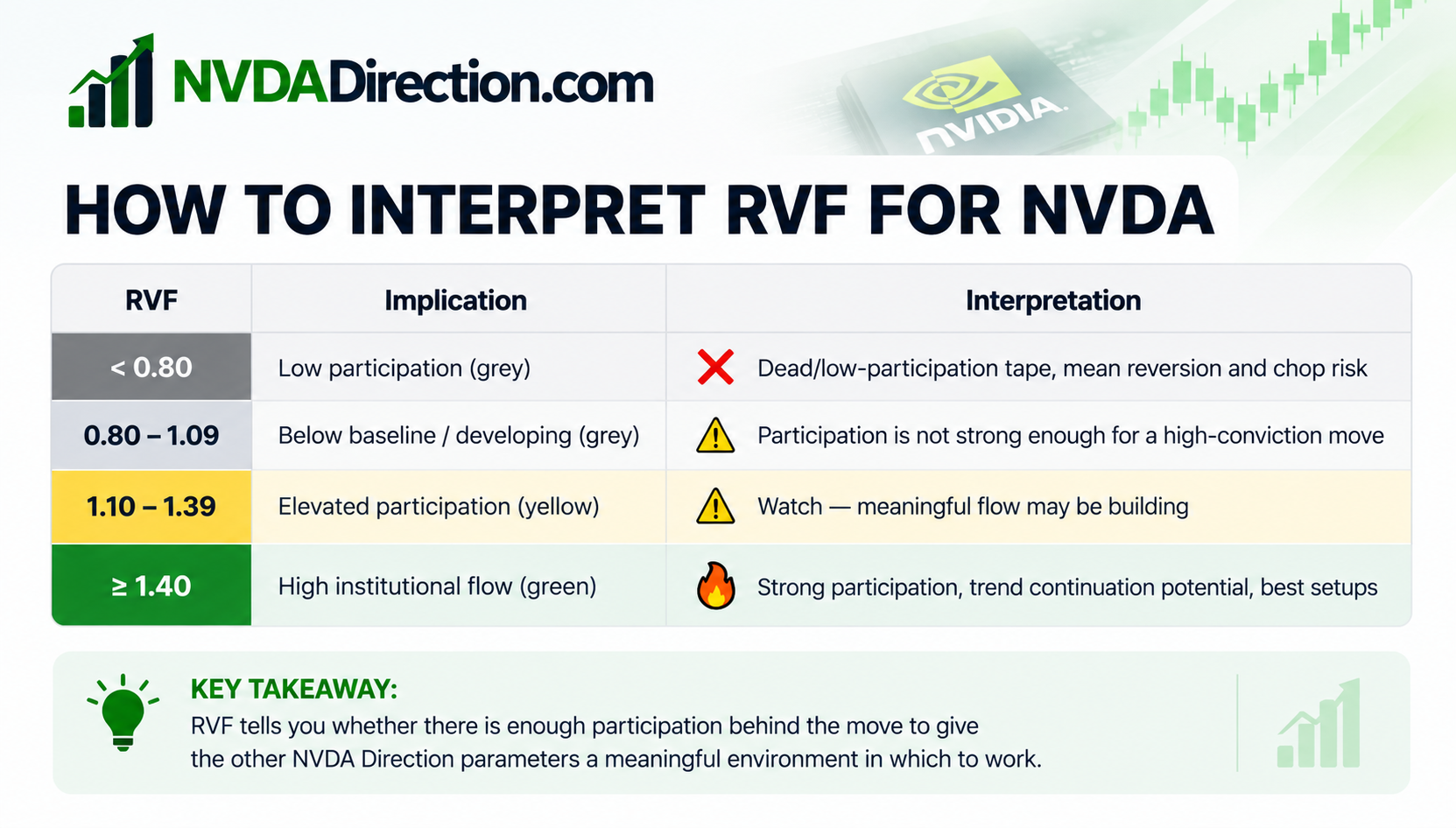
🎯 HOW TO INTERPRET RVF FOR NVDA
| RVF | Implication | Interpretation |
|---|---|---|
| < 0.80 | Low participation (grey) | ❌ Dead/low-participation tape, mean reversion and chop risk |
| 0.80 – 1.09 | Below baseline / developing (red) | ⚠️ Participation is not strong enough for a high-conviction move |
| 1.10 – 1.39 | Elevated participation (yellow) | ⚠️ Watch — meaningful flow may be building |
| ≥ 1.40 | High institutional flow (green) | 🔥 Strong participation, trend continuation potential, best setups |
Never Miss an RVF Signal
NVDA Direction can automatically send a text message whenever your selected RVF thresholds are reached.
Learn how to enable SMS Alerts
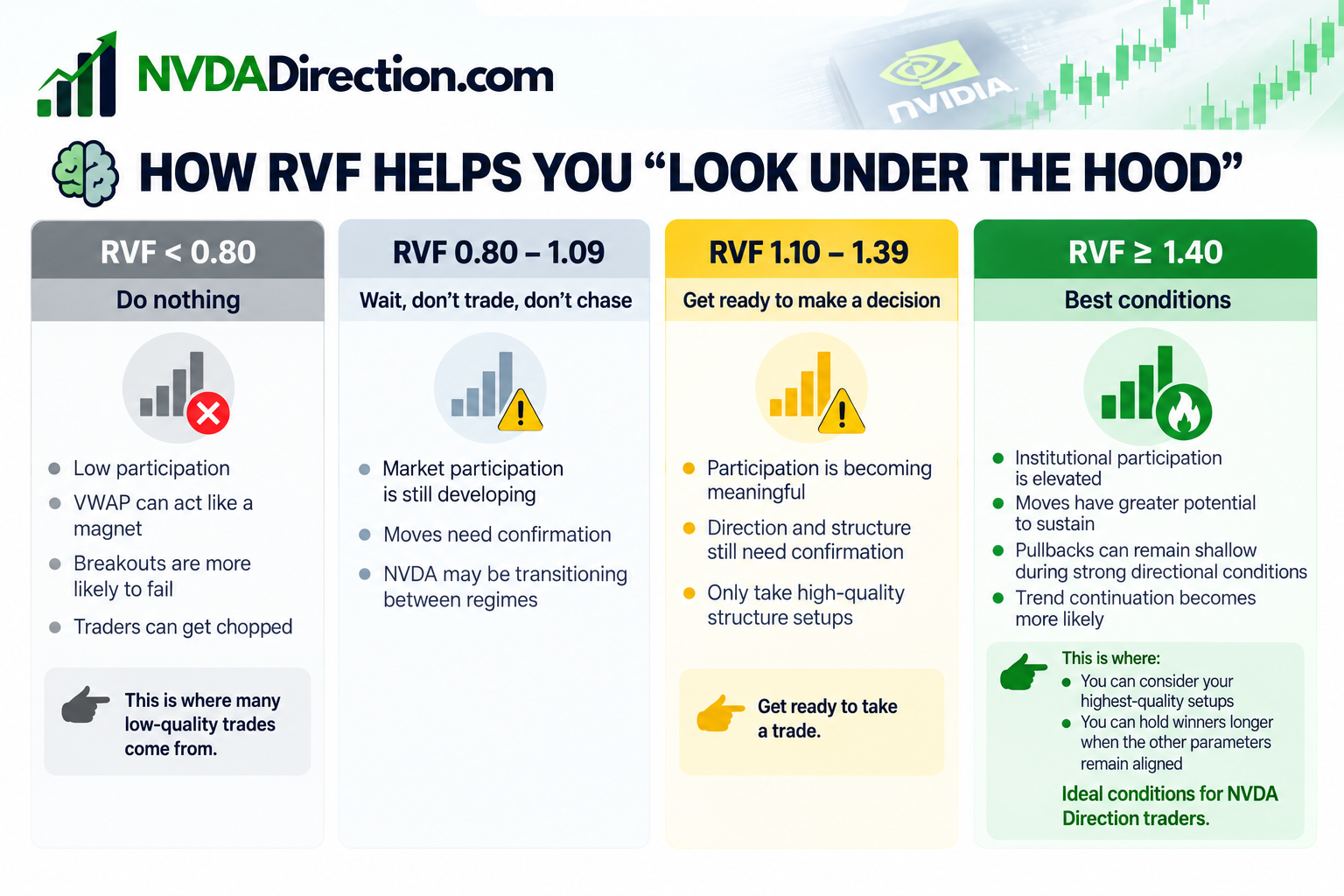
🧠 HOW RVF HELPS YOU “LOOK UNDER THE HOOD”
❌ RVF < 0.80 → Do nothing
- Low participation
- VWAP can act like a magnet
- Breakouts are more likely to fail
- Traders can get chopped
👉 This is where many low-quality trades come from.
⚠️ RVF 0.80 – 1.09 → Wait, don’t trade, don’t chase
- Market participation is still developing
- Moves need confirmation
- NVDA may be transitioning between regimes
⚠️ RVF 1.10 – 1.39 → Get ready to make a decision
- Participation is becoming meaningful
- Direction and structure still need confirmation
- Only take high-quality structure setups
👉 Get ready to take a trade.
🔥 RVF ≥ 1.40 → Best conditions
- Institutional participation is elevated
- Moves have greater potential to sustain
- Pullbacks can remain shallow during strong directional conditions
- Trend continuation becomes more likely
👉 This is where:
- You can consider your highest-quality setups
- You can hold winners longer when the other parameters remain aligned
Ideal conditions for NVDA Direction traders.
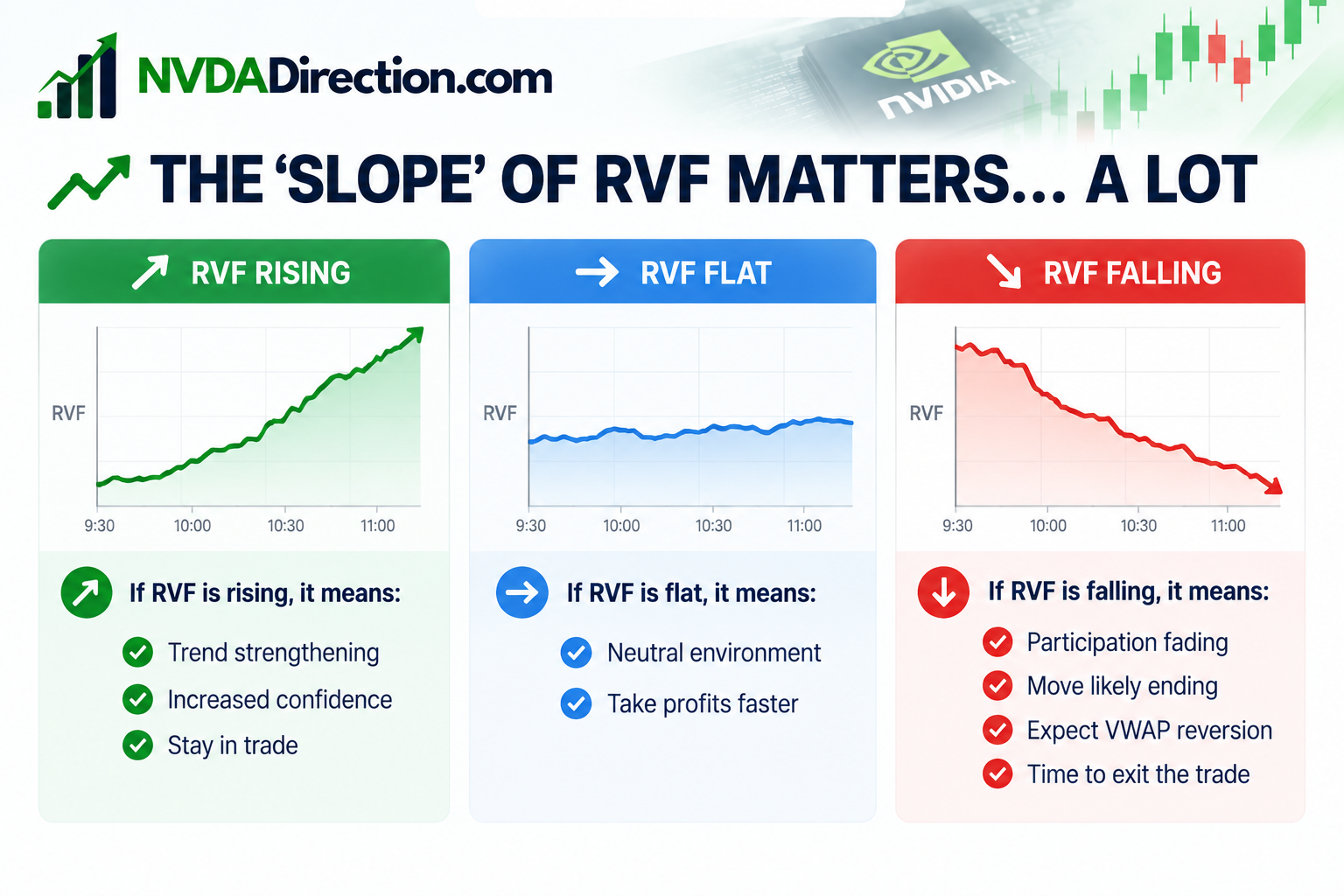
⚡ THE ‘SLOPE’ OF RVF MATTERS… A LOT
The sharper the angle of the slope, the faster the change in volume.
When institutions accumulate, they do it quickly at times, which results in a sharp change in the angle of the slope. As they continue accumulating, the slope continues to rise (increase in volume). As their interest declines, the slope starts to fall (decrease in volume). This generally signals the end of a trend - participation fades as volume drops. The NVDA Direction RVF slope allows you to see this in real time, since it is calculated dynamically based on level 3 (depth of market) data.
If RVF is rising, it means:
→ Trend strengthening
→ Increased confidence
→ Stay in trade
If RVF is flat, it means:
→ Neutral environment
→ Take profits faster
If RVF is falling, it means:
→ Participation fading
→ Move likely ending
→ Expect VWAP reversion
→ Time to exit the trade
RVF tells you if the market is making a ‘real move’ led by institutions and when it ‘dies out’. NVDA Direction members should monitor RVF trend in addition to RVF value.
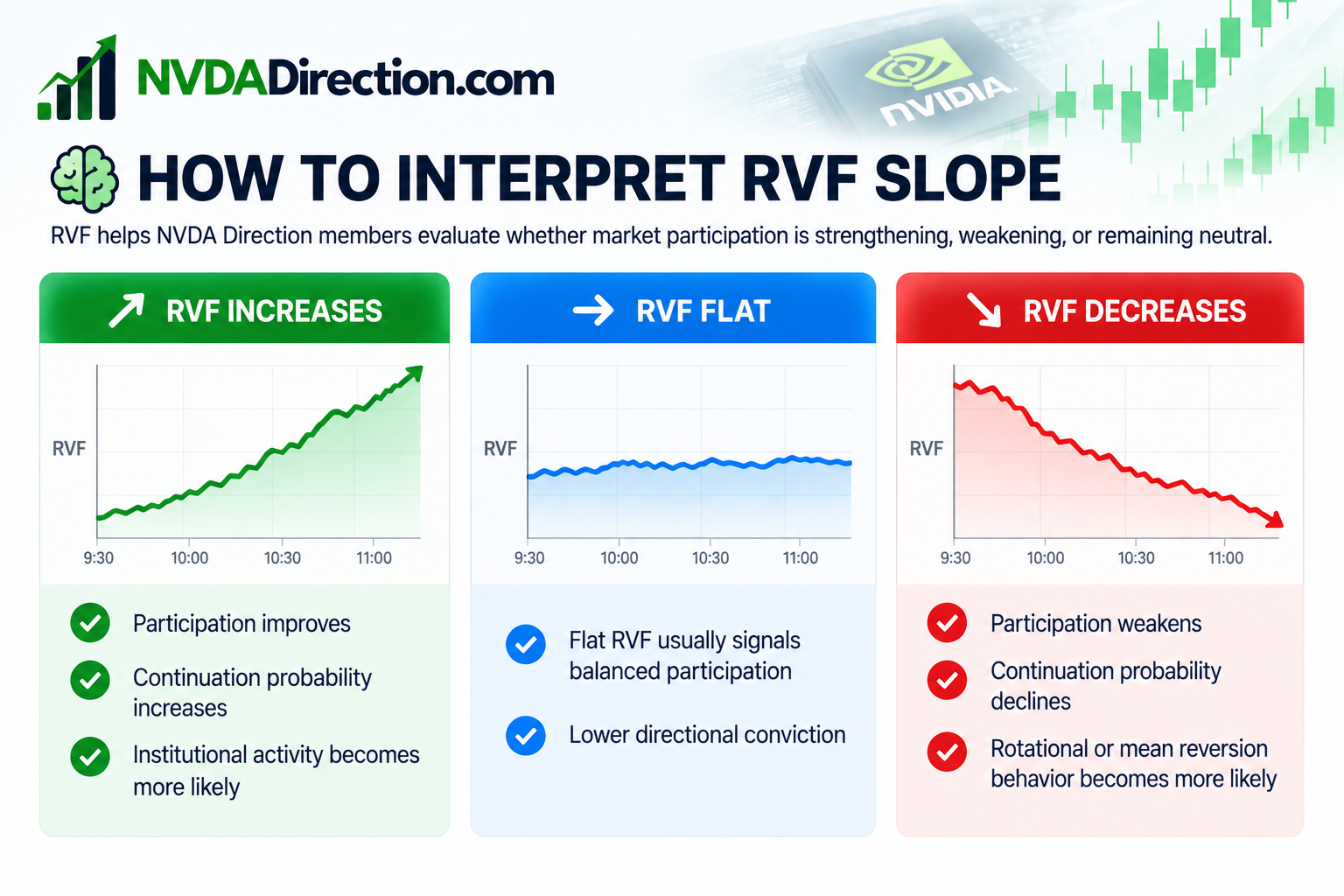
🧠 HOW TO INTERPRET RVF SLOPE
RVF helps NVDA Direction members evaluate whether market participation is strengthening, weakening, or remaining neutral.
As RVF increases:
- participation improves
- continuation probability increases
- institutional activity becomes more likely
As RVF decreases:
- participation weakens
- continuation probability declines
- rotational or mean reversion behavior becomes more likely
Flat RVF usually signals balanced participation and lower directional conviction.
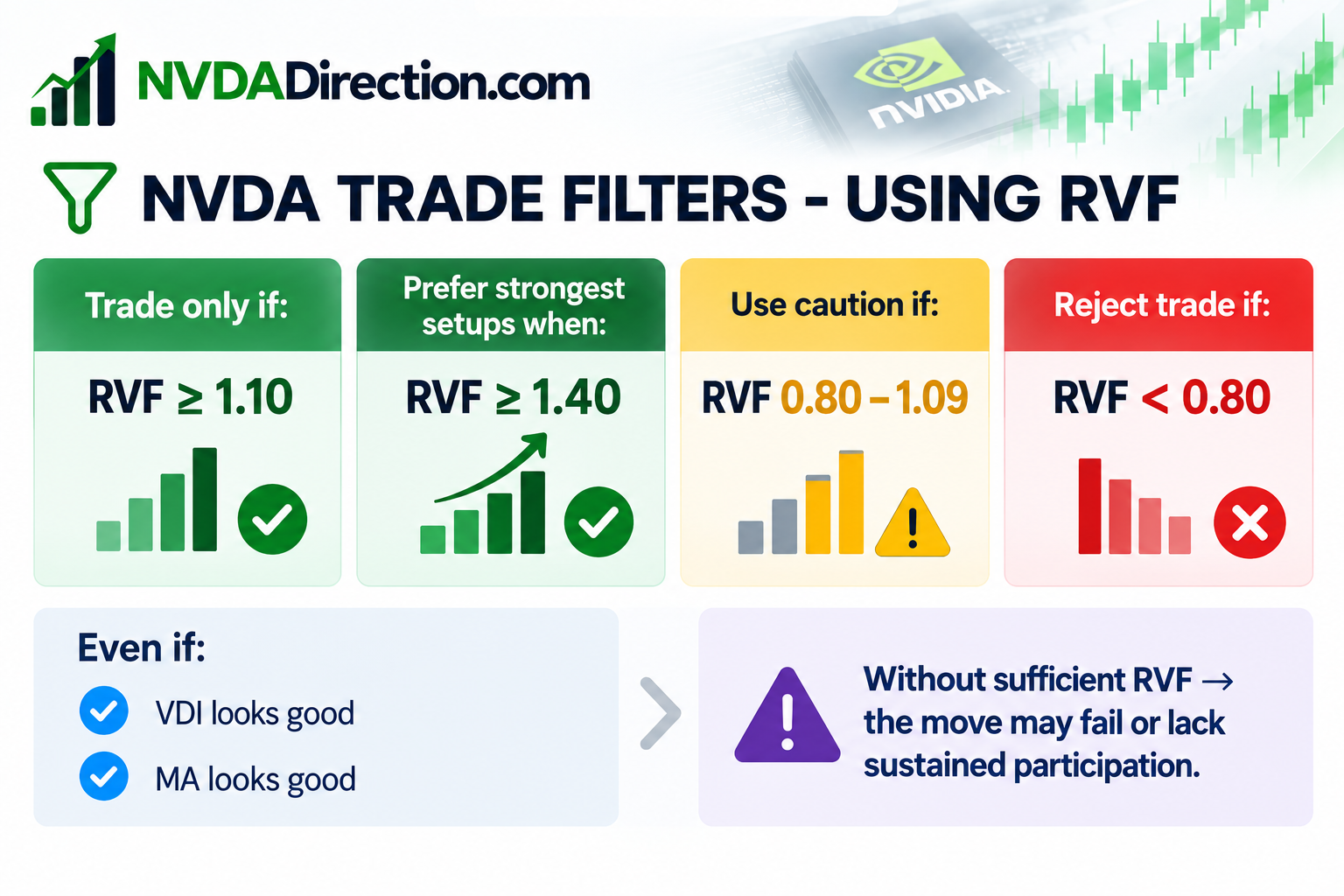
⚡ NVDA TRADE FILTERS - USING RVF
Trade only if:
RVF ≥ 1.10
Prefer strongest setups when:
RVF ≥ 1.40
Reject trade if:
RVF < 0.80
Use caution if:
RVF 0.80 – 1.09
Even if:
- VDI looks good
- MA looks good
Without sufficient RVF → the move may fail or lack sustained participation.
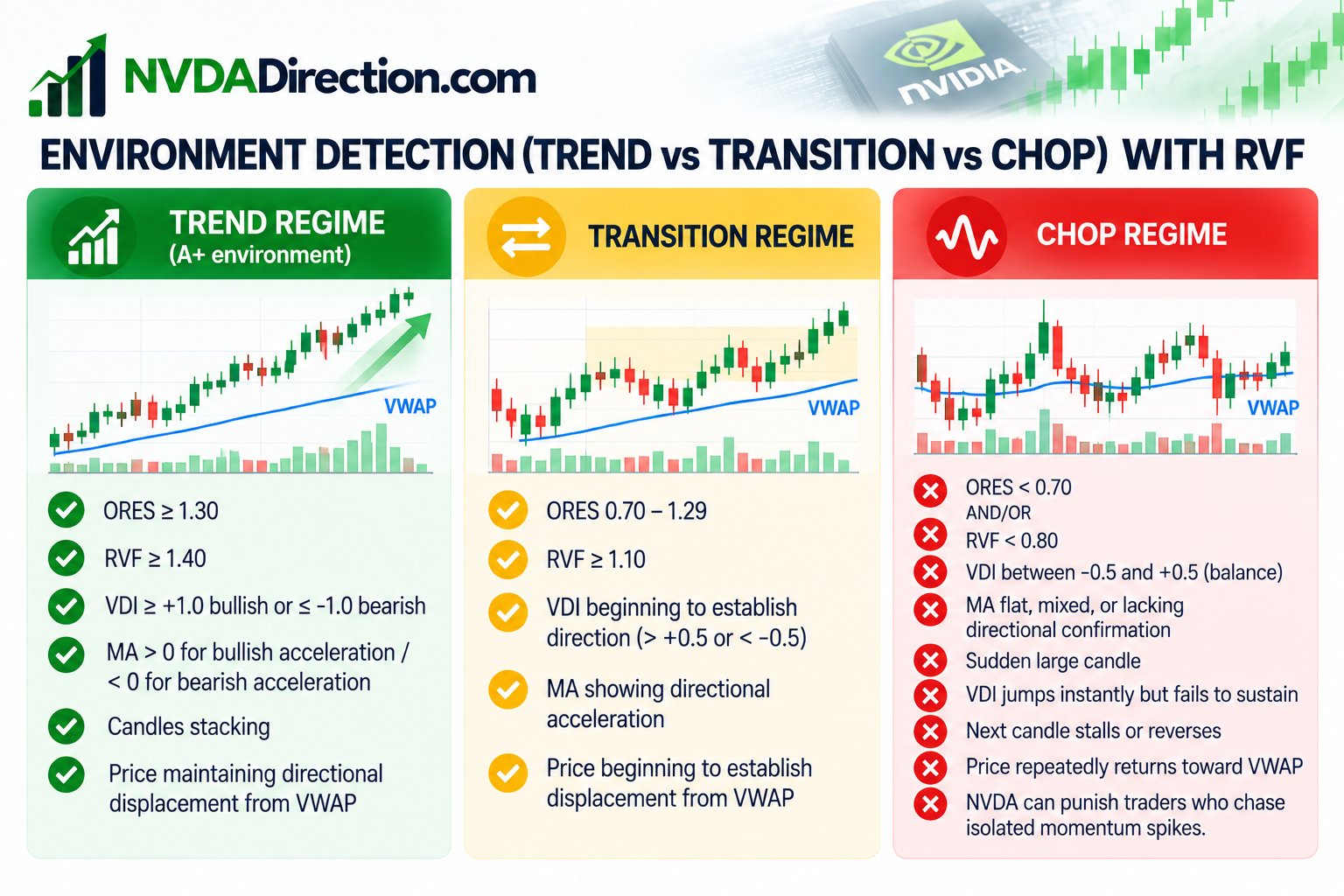
ENVIRONMENT DETECTION (TREND vs TRANSITION vs CHOP) WITH RVF
🟢 TREND REGIME (A+ environment)
ORES ≥ 1.30
RVF ≥ 1.40
VDI ≥ +1.0 bullish or ≤ -1.0 bearish
MA > 0 for bullish acceleration / < 0 for bearish acceleration
Candles stacking
Price maintaining directional displacement from VWAP
🟡 TRANSITION REGIME
ORES 0.70 – 1.29
AND
RVF ≥ 1.10
AND
VDI beginning to establish direction (> +0.5 or < -0.5)
AND
MA showing directional acceleration
Price beginning to establish displacement from VWAP
❌ CHOP REGIME
ORES < 0.70
AND/OR
RVF < 0.80
AND
VDI between -0.5 and +0.5 (balance)
MA flat, mixed, or lacking directional confirmation
Sudden large candle
VDI jumps instantly but fails to sustain
Next candle stalls or reverses
Price repeatedly returns toward VWAP
NVDA can punish traders who chase isolated momentum spikes.
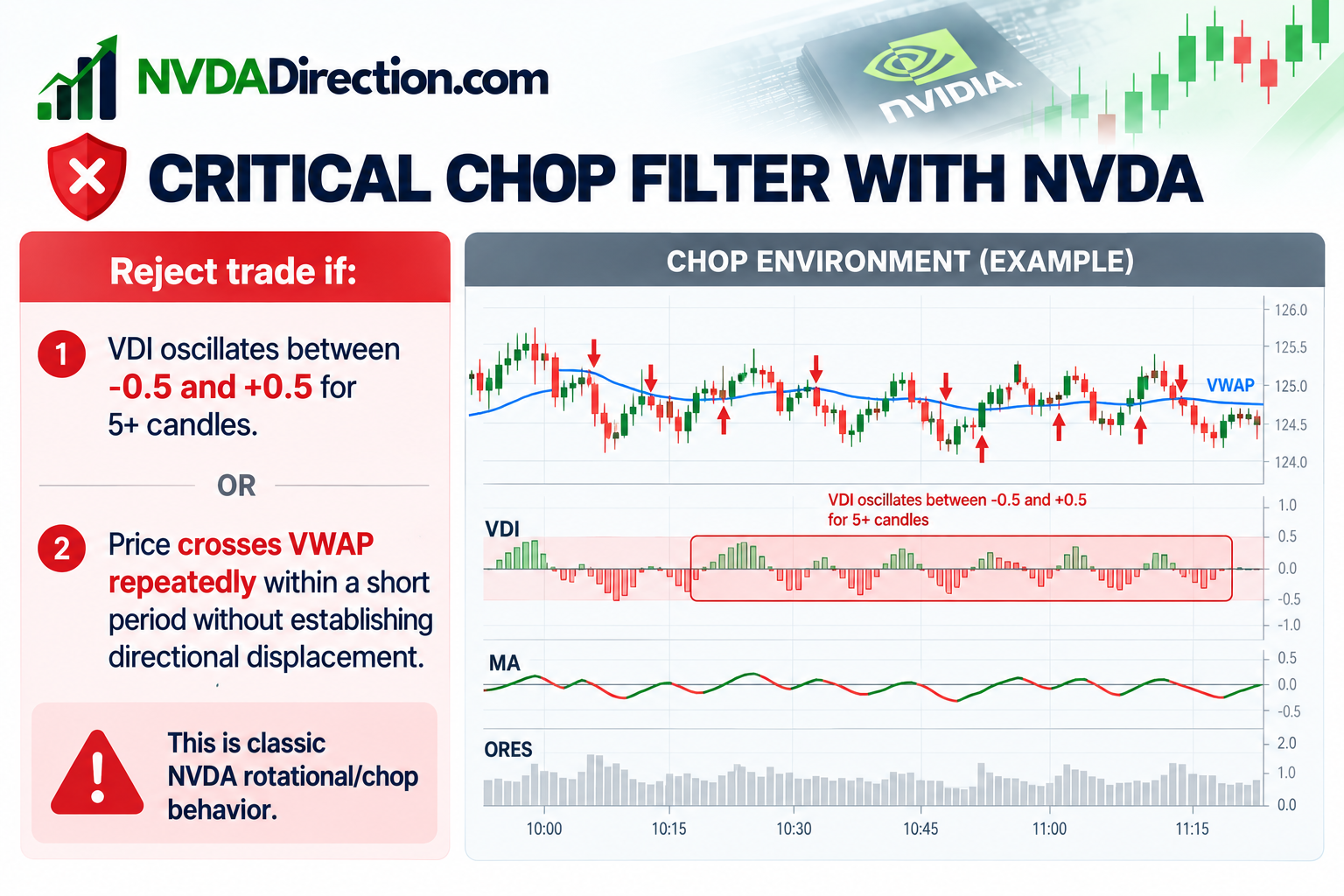
🛡️ CRITICAL CHOP FILTER WITH NVDA
Reject trade if:
VDI oscillates between -0.5 and +0.5 for 5+ candles
OR
Price crosses VWAP repeatedly within a short period without establishing directional displacement.
This is classic NVDA rotational/chop behavior.
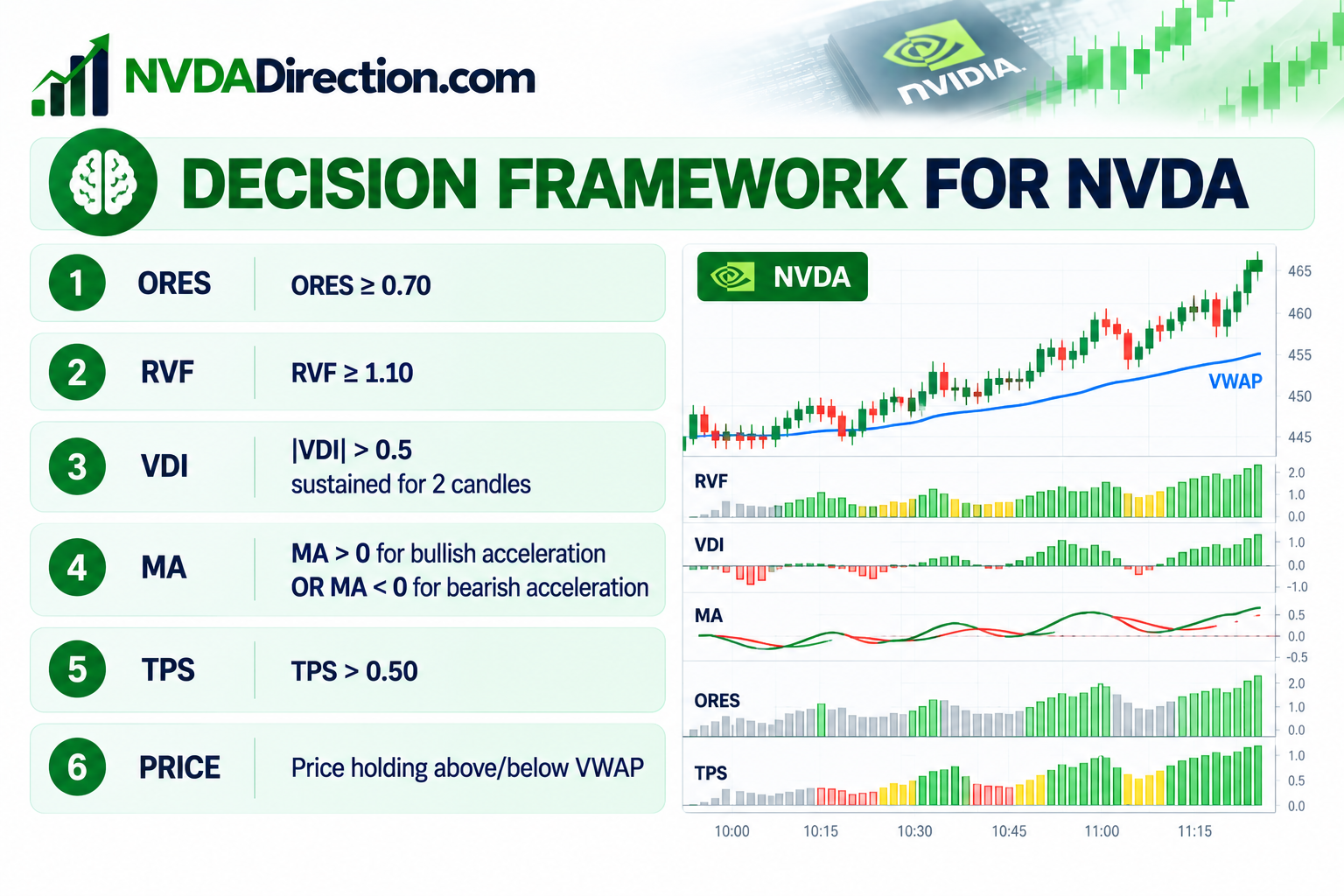
🧠 DECISION FRAMEWORK FOR NVDA
TRADE if:
ORES ≥ 0.70
AND
RVF ≥ 1.10
AND
|VDI| > 0.5 sustained for 2 candles
AND
MA > 0 for bullish acceleration OR MA < 0 for bearish acceleration
AND
TPS > 0.50
AND
Price holding above/below VWAP
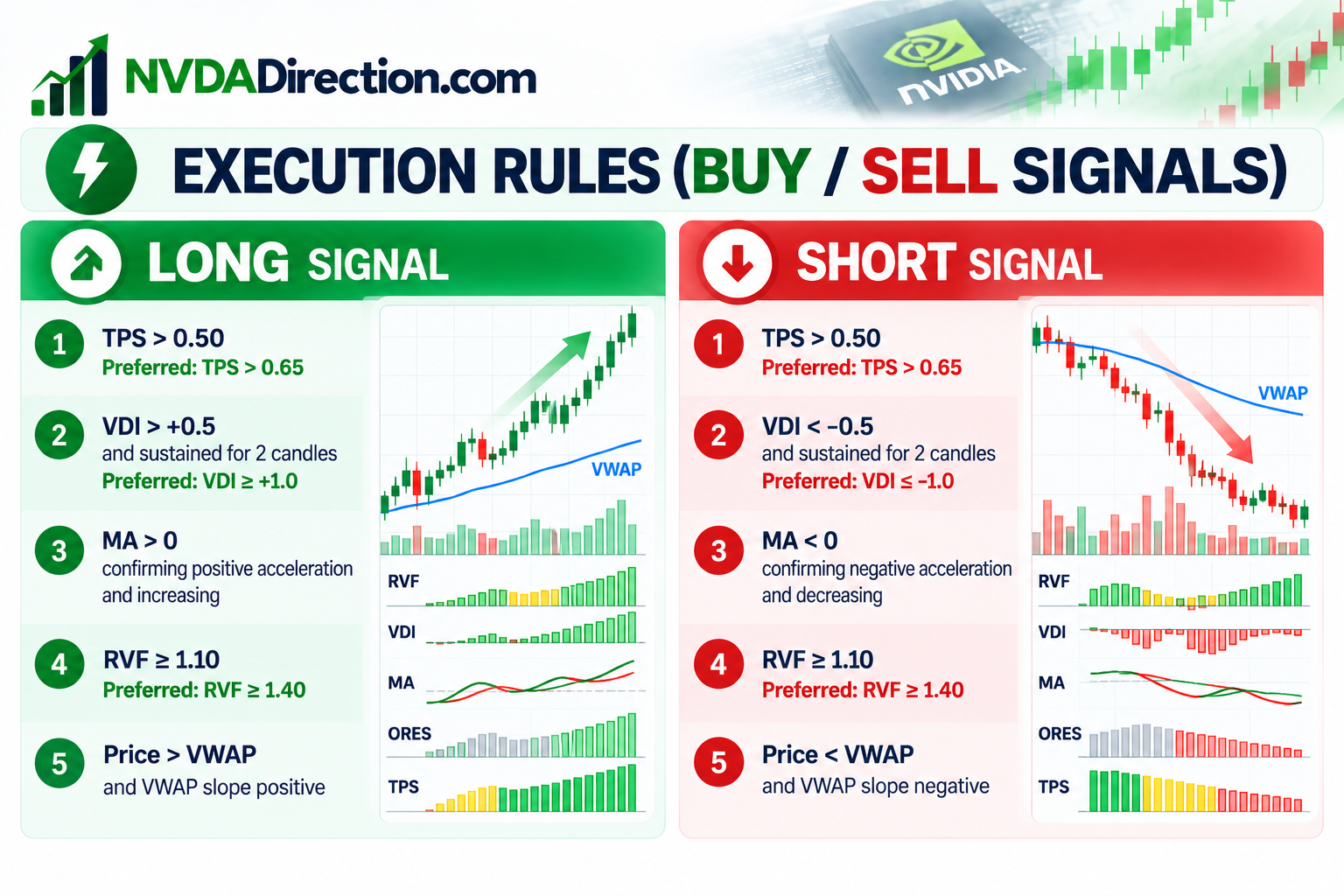
⚡ EXECUTION RULES (BUY / SELL SIGNALS)
🟢 LONG SIGNAL
TPS > 0.50
Preferred: TPS > 0.65
VDI > +0.5
AND sustained for 2 candles
Preferred: VDI ≥ +1.0
MA > 0
Confirming positive acceleration and increasing
RVF ≥ 1.10
Preferred: RVF ≥ 1.40
Price > VWAP
AND VWAP slope is positive.
🔴 SHORT SIGNAL
TPS > 0.50
Preferred: TPS > 0.65
VDI < -0.5
AND sustained for 2 candles
Preferred: VDI ≤ -1.0
MA < 0
Confirming negative acceleration and decreasing
RVF ≥ 1.10
Preferred: RVF ≥ 1.40
Price < VWAP
AND VWAP slope is negative.
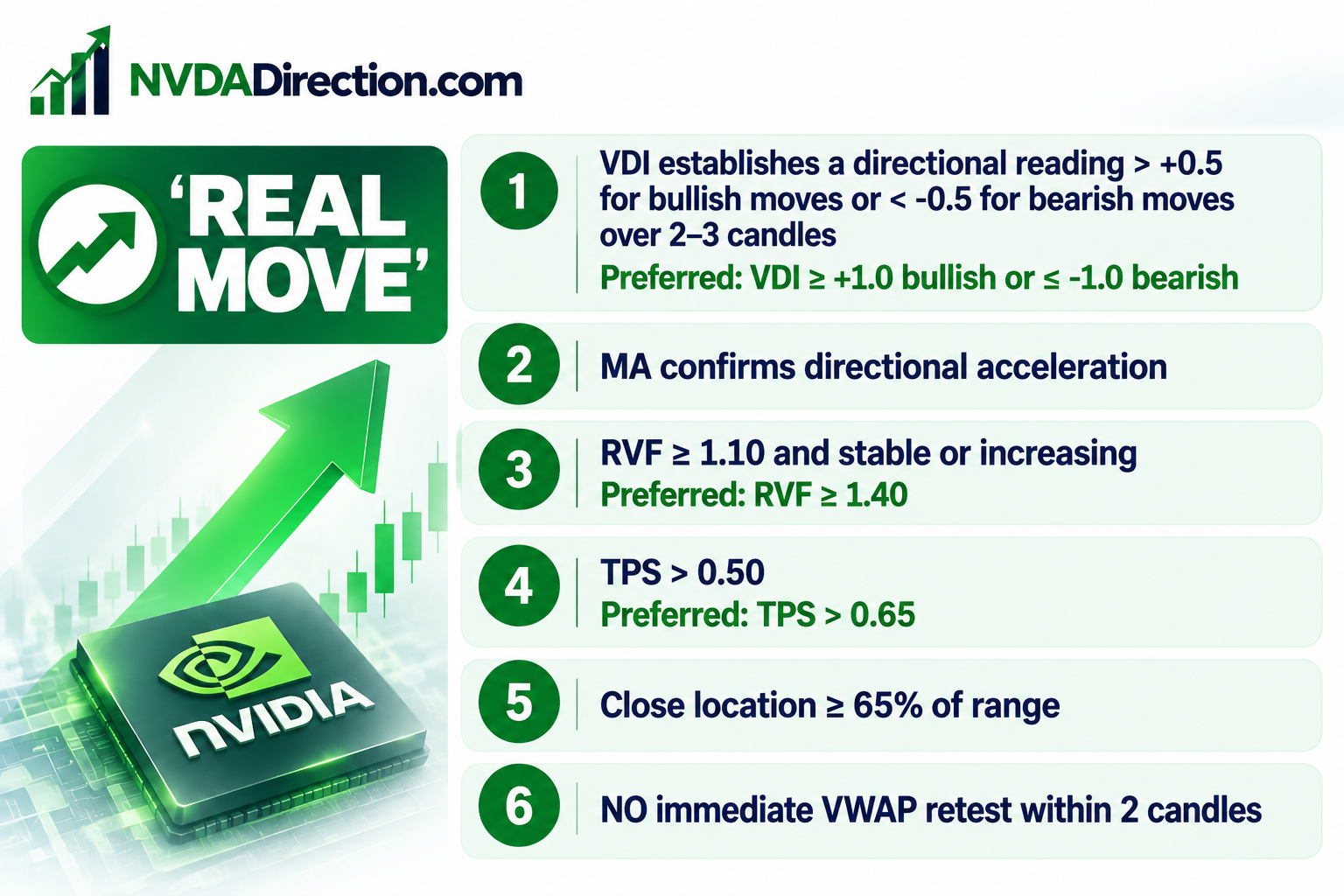
🔥 ‘REAL MOVE’ vs ‘FAKEOUT’ IN NVDA
✅ ‘REAL MOVE’
VDI establishes a directional reading > +0.5 for bullish moves or < -0.5 for bearish moves over 2–3 candles
Preferred: VDI ≥ +1.0 bullish or ≤ -1.0 bearish
MA confirms directional acceleration
RVF ≥ 1.10 and stable or increasing
Preferred: RVF ≥ 1.40
TPS > 0.50
Preferred: TPS > 0.65
Close location ≥ 65% of range
NO immediate VWAP retest within 2 candles
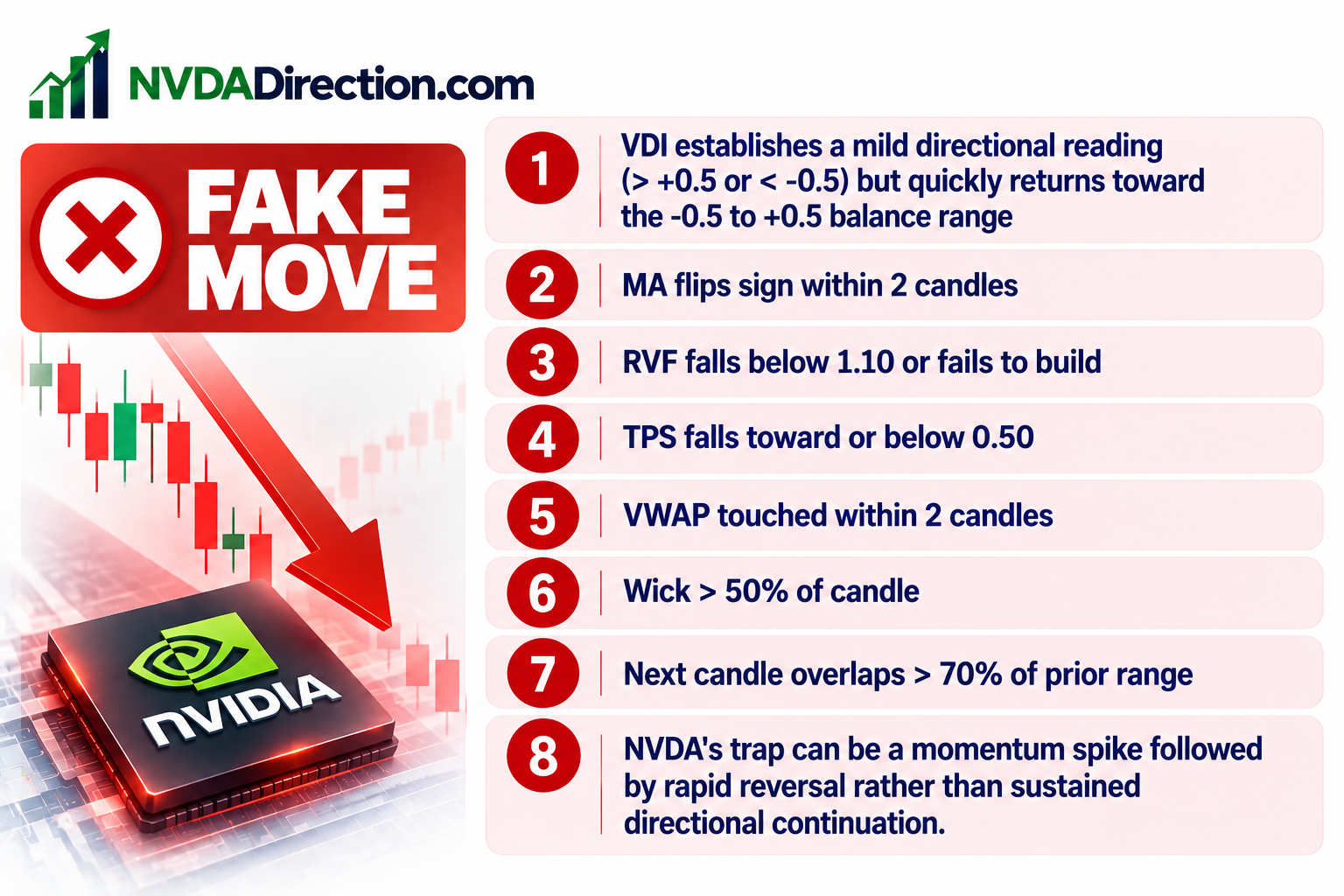
❌ FAKE MOVE (COMMON IN NVDA)
VDI establishes a mild directional reading (> +0.5 or < -0.5) but quickly returns toward the -0.5 to +0.5 balance range
MA flips sign within 2 candles
RVF falls below 1.10 or fails to build
TPS falls toward or below 0.50
VWAP touched within 2 candles
Wick > 50% of candle
Next candle overlaps > 70% of prior range
NVDA's trap can be a momentum spike followed by rapid reversal rather than sustained directional continuation.
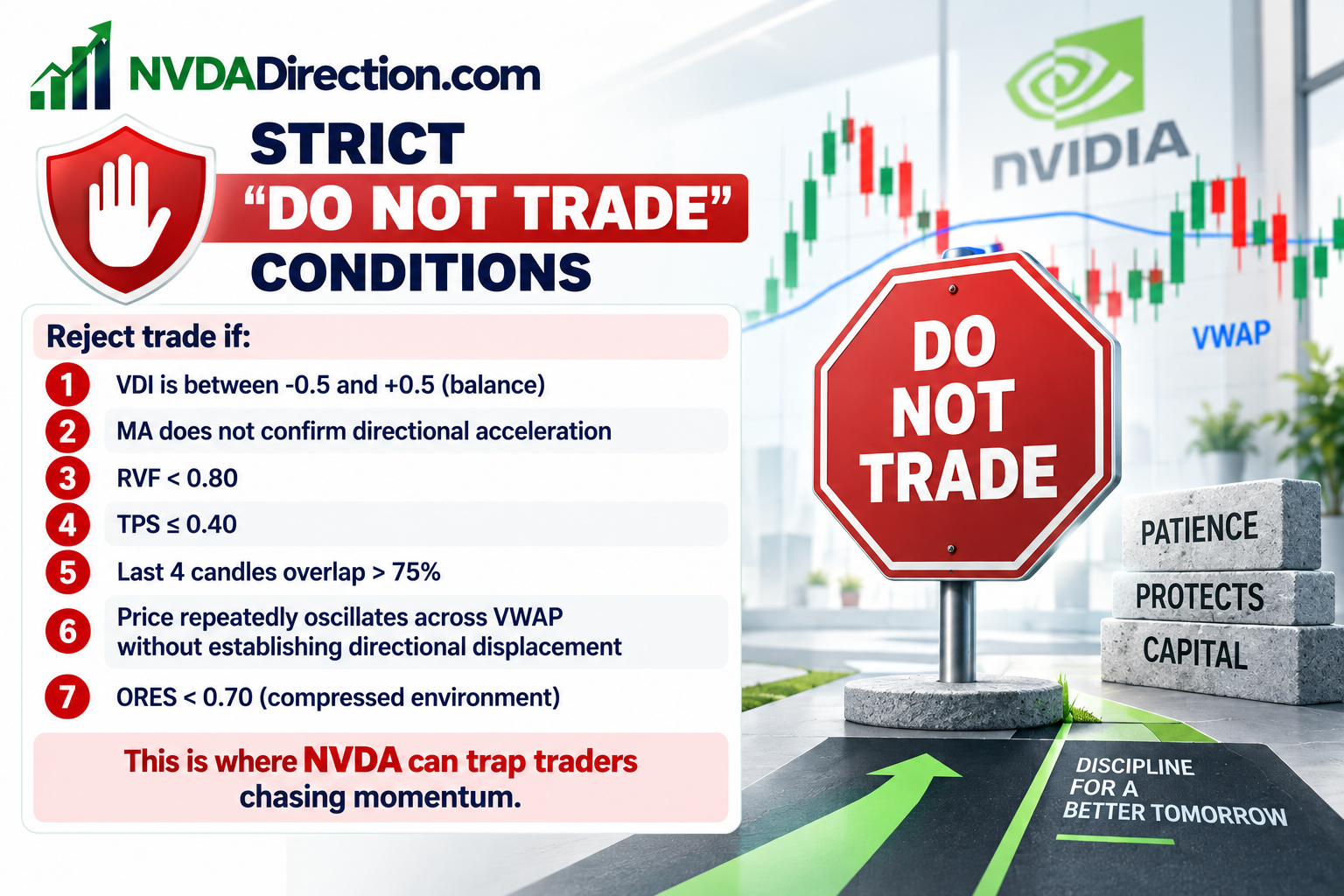
🛡️ STRICT “DO NOT TRADE” CONDITIONS
Reject trade if:
VDI is between -0.5 and +0.5 (balance)
MA does not confirm directional acceleration
RVF < 0.80
TPS ≤ 0.40
Last 4 candles overlap > 75%
Price repeatedly oscillates across VWAP without establishing directional displacement
ORES < 0.70 (compressed environment)
This is where NVDA can trap traders chasing momentum.
⏱️ BEST WINDOW TO TRADE
No trades before 10:00 AM EST
BEST window: 10:00–11:30 AM EST
Trading window ends at 11:30 AM EST.

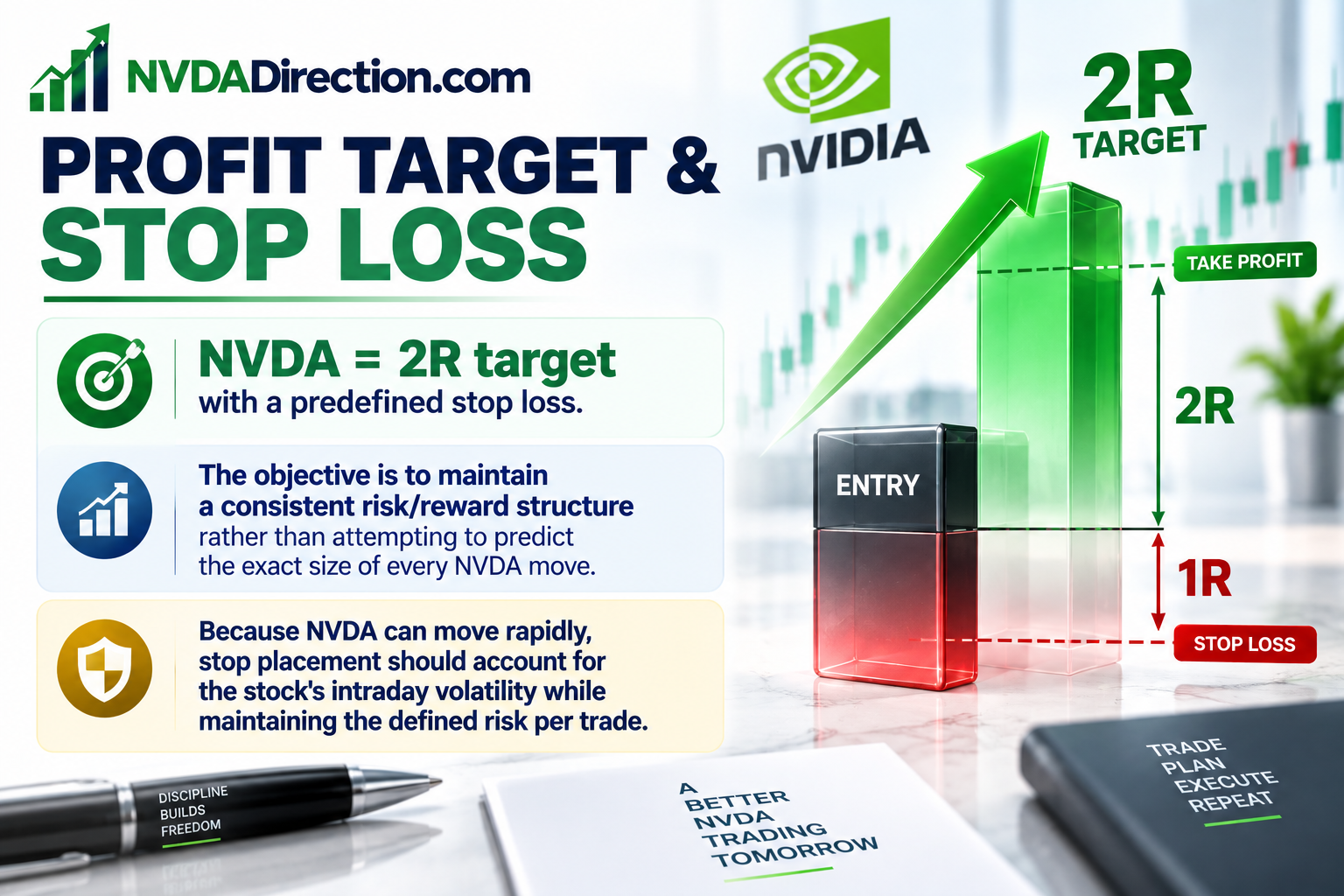
💰 PROFIT TARGET & STOP LOSS
NVDA = 2R target with a predefined stop loss.
The objective is to maintain a consistent risk/reward structure rather than attempting to predict the exact size of every NVDA move.
Because NVDA can move rapidly, stop placement should account for the stock's intraday volatility while maintaining the defined risk per trade.
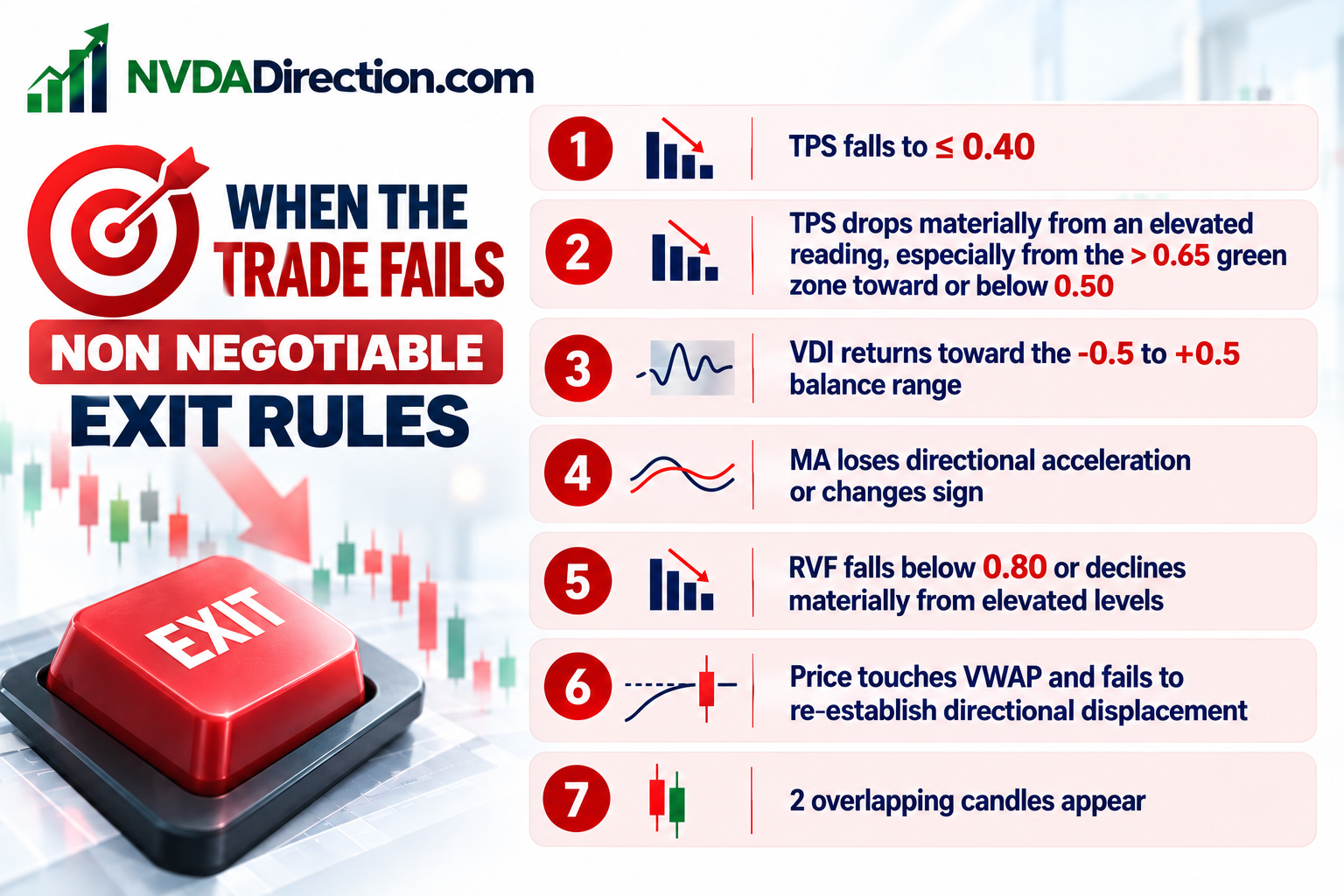
🎯 WHEN THE TRADE FAILS - NON NEGOTIABLE EXIT RULES
EXIT EARLY IF:
TPS falls to ≤ 0.40
TPS drops materially from an elevated reading, especially from the > 0.65 green zone toward or below 0.50
VDI returns toward the -0.5 to +0.5 balance range
MA loses directional acceleration or changes sign
RVF falls below 0.80 or declines materially from elevated levels
Price touches VWAP and fails to re-establish directional displacement
2 overlapping candles appear
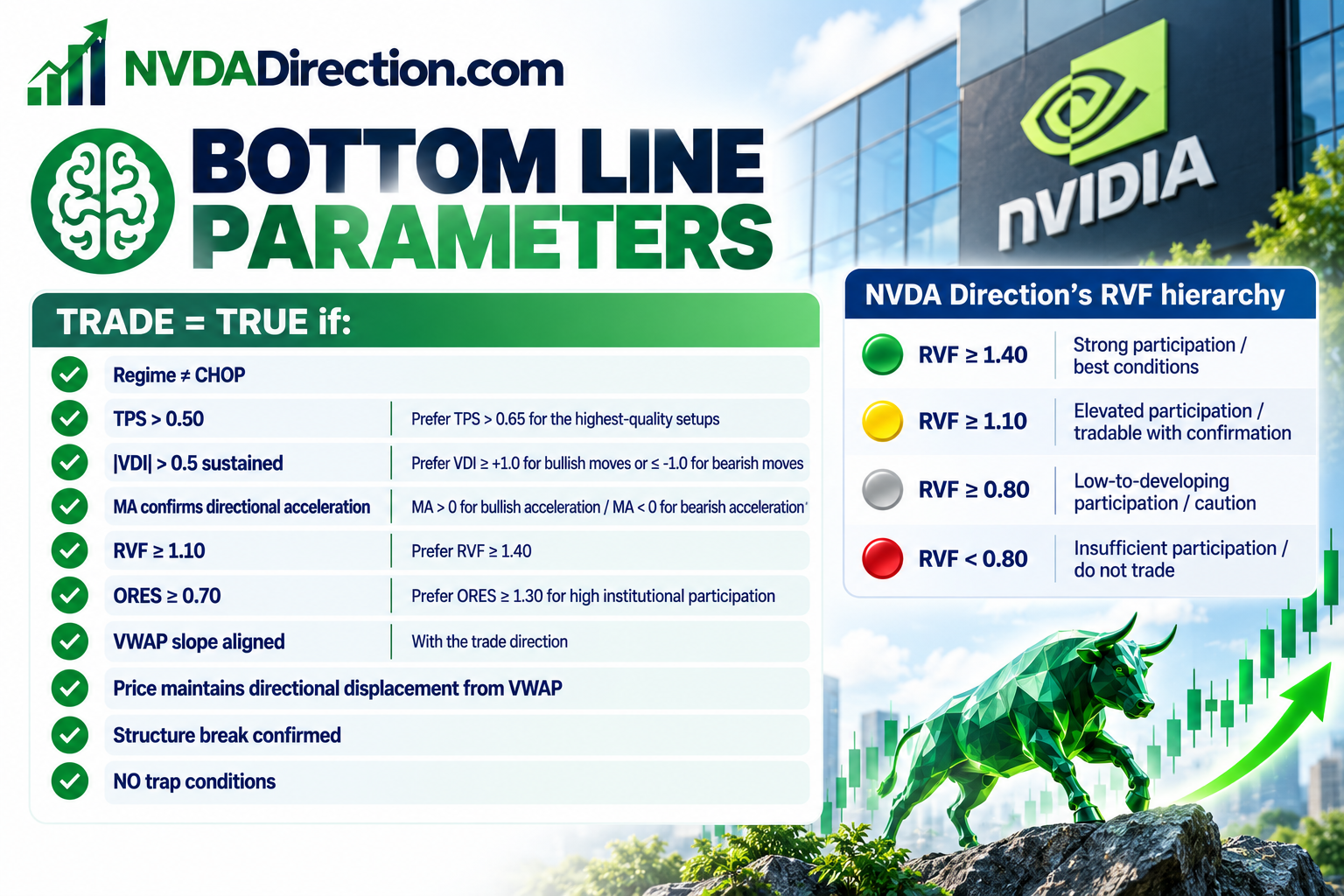
🧠 BOTTOM LINE PARAMETERS
TRADE = TRUE if:
Regime ≠ CHOP
AND
TPS > 0.50
Prefer TPS > 0.65 for the highest-quality setups
AND
|VDI| > 0.5 sustained
Prefer VDI ≥ +1.0 for bullish moves or ≤ -1.0 for bearish moves
AND
MA confirms directional acceleration
MA > 0 for bullish acceleration / MA < 0 for bearish acceleration
AND
RVF ≥ 1.10
Prefer RVF ≥ 1.40
AND
ORES ≥ 0.70
Prefer ORES ≥ 1.30 for high institutional participation
AND
VWAP slope aligned with the trade direction
AND
Price maintains directional displacement from VWAP
AND
Structure break confirmed
AND
NO trap conditions
NVDA Direction's RVF hierarchy
🟢 RVF ≥ 1.40 → Strong participation / best conditions
🟡 RVF ≥ 1.10 → Elevated participation / tradable with confirmation
⚪ RVF ≥ 0.80 → Low-to-developing participation / caution
⚪ RVF < 0.80 → Insufficient participation / do not trade