Momentum Analysis (MA)
Contact customer support at support@nvdadirection.com
Momentum Acceleration (MA)
Measures how fast momentum is increasing or decreasing — not just direction, but change in speed
🧠 Formula
MA = (Current 5m return) − (Previous 5m return)
Where:
-
5m return = % change of each 5-minute candle
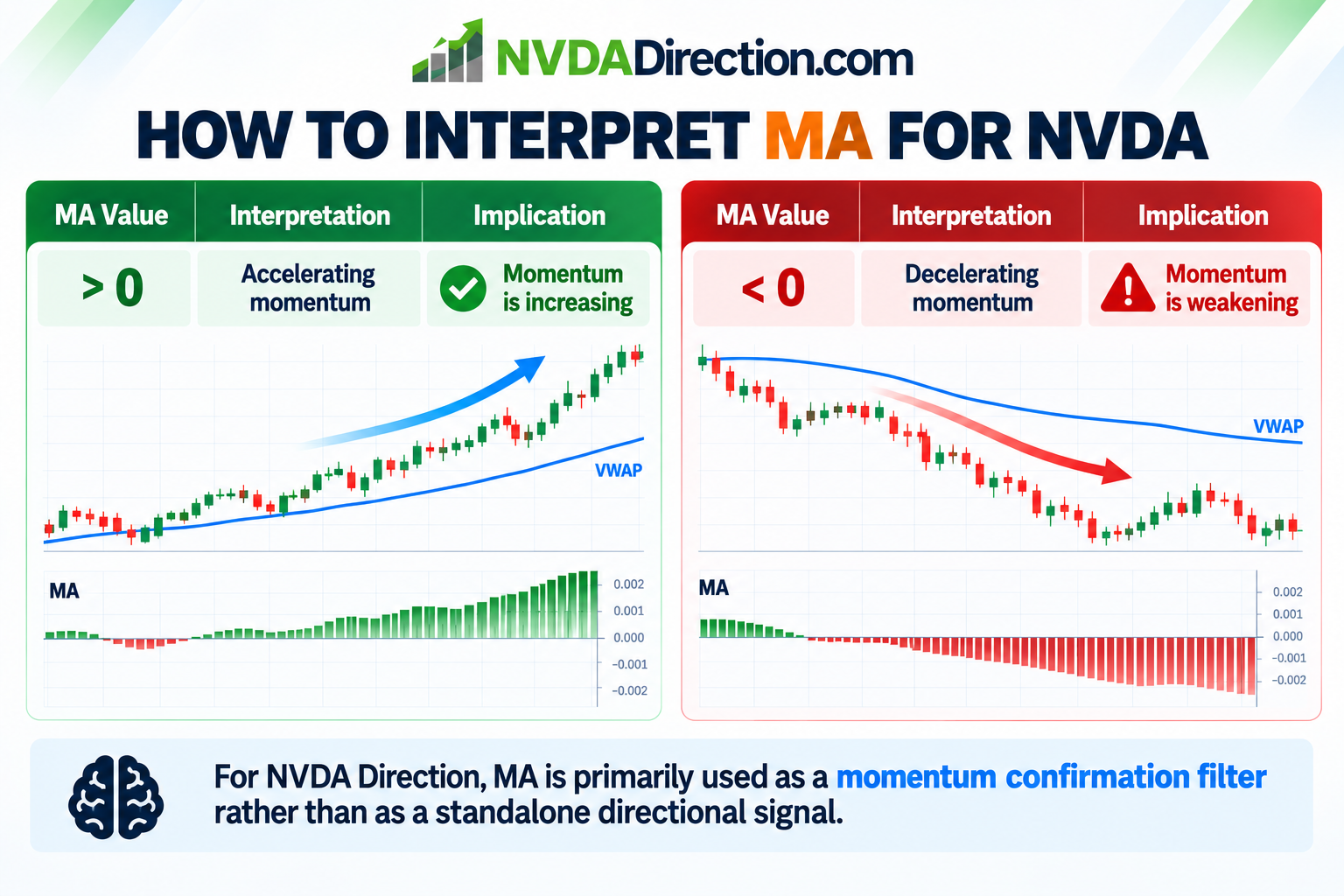
🧠 HOW TO INTERPRET MA FOR NVDA
| MA Value | Interpretation | Implication |
|---|---|---|
| > 0 | Accelerating momentum | ✅ Momentum is increasing |
| < 0 | Decelerating momentum | ⚠️ Momentum is weakening |
For NVDA Direction, MA is primarily used as a momentum confirmation filter rather than as a standalone directional signal.
Never Miss an MA Signal
NVDA Direction can automatically send a text message whenever your selected MA thresholds are reached.
Learn how to enable SMS Alerts
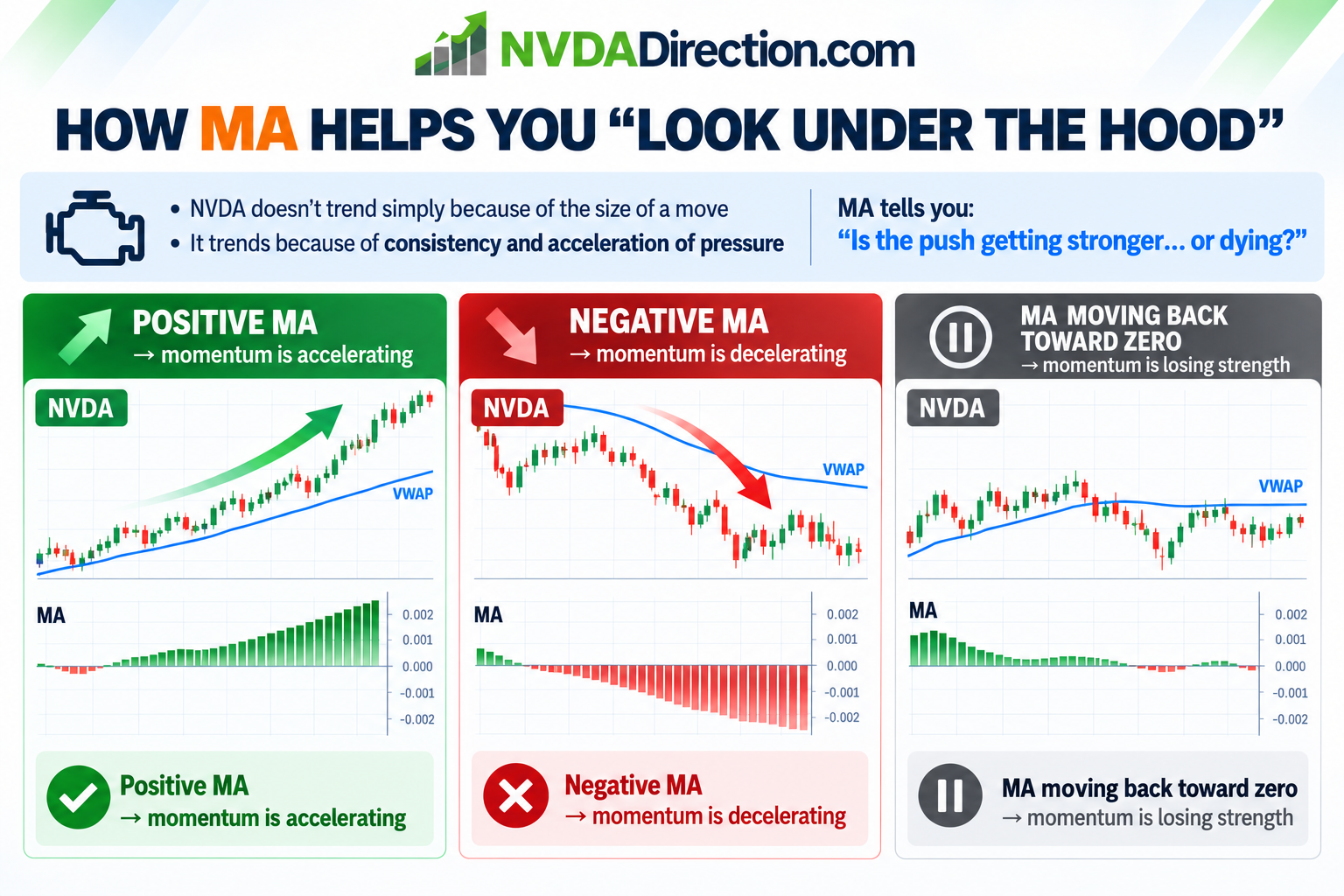
🧠 HOW MA HELPS YOU “LOOK UNDER THE HOOD”
-
NVDA doesn’t trend simply because of the size of a move
-
It trends because of consistency and acceleration of pressure
MA tells you:
“Is the push getting stronger… or dying?”
-
Positive MA → momentum is accelerating
-
Negative MA → momentum is decelerating
-
MA moving back toward zero → momentum is losing strength
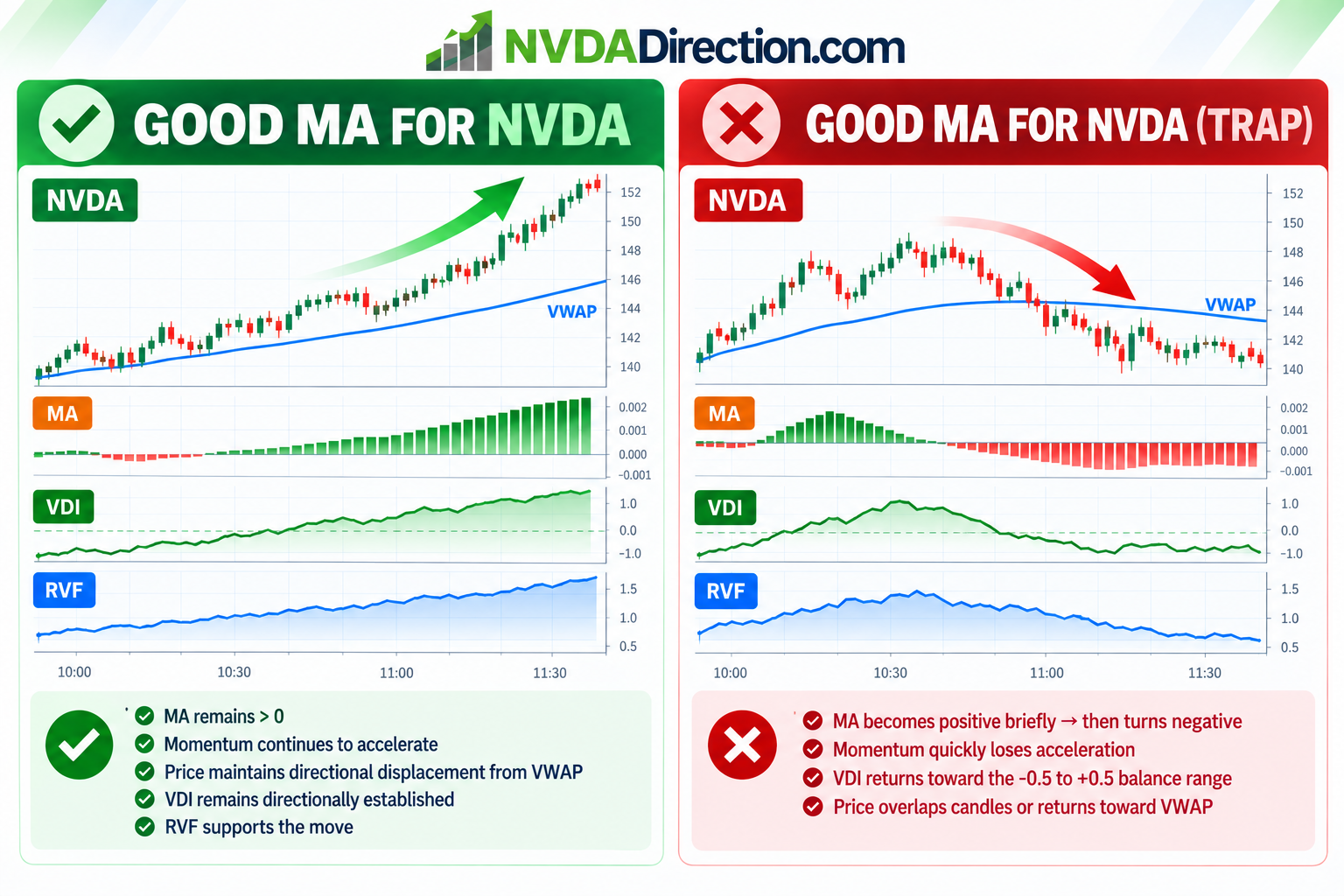
🔥 GOOD MA FOR NVDA
✅ Sustained trend behavior
-
MA remains > 0
-
Momentum continues to accelerate
-
Price maintains directional displacement from VWAP
-
VDI remains directionally established
-
RVF supports the move
👉 This is real momentum buildup
❌ GOOD MA FOR NVDA (TRAP)
🚩 Fake move
-
MA becomes positive briefly → then turns negative
-
Momentum quickly loses acceleration
-
VDI returns toward the -0.5 to +0.5 balance range
-
Price overlaps candles or returns toward VWAP
👉 This is momentum failure, not sustained directional continuation.
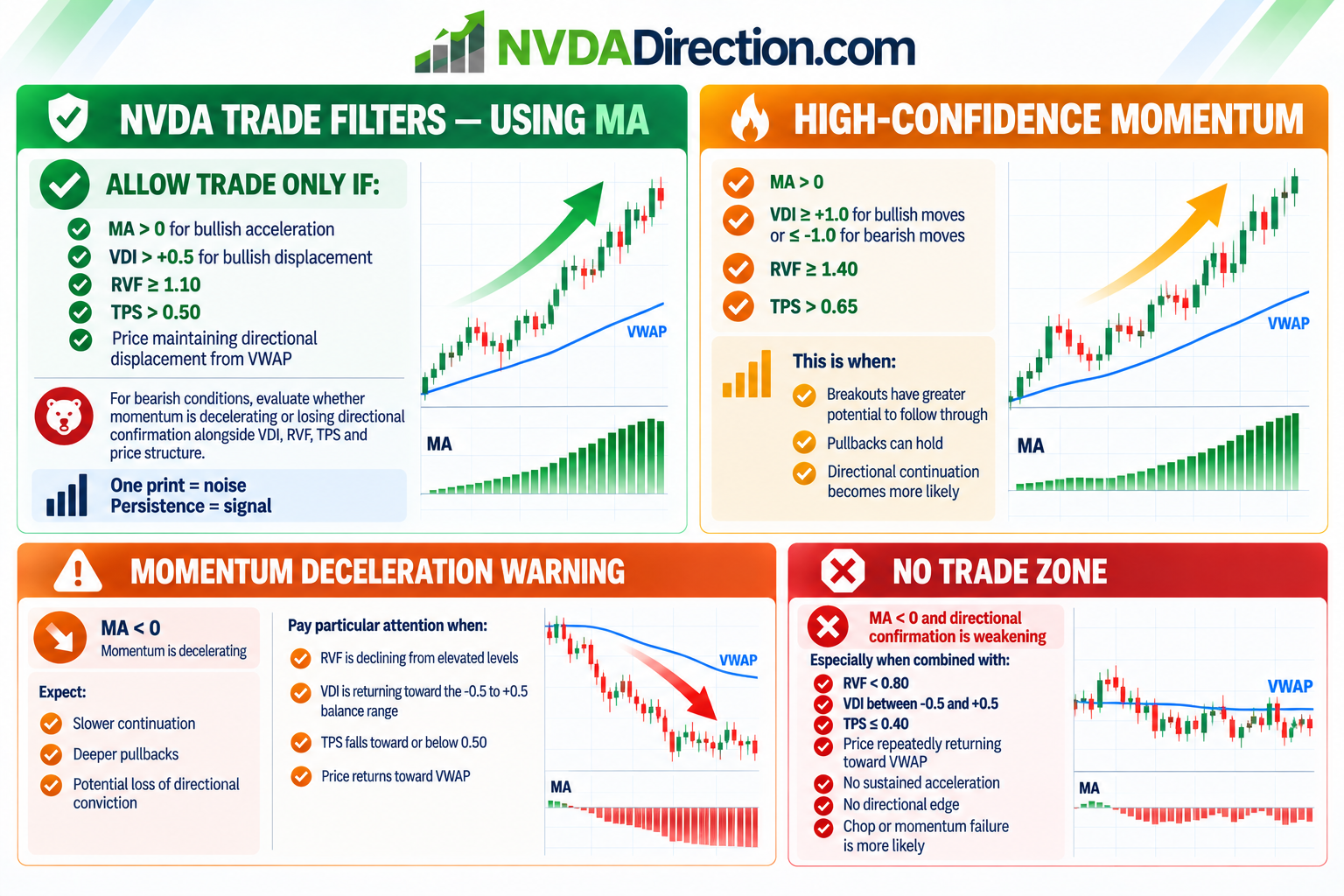
🛡️ NVDA TRADE FILTERS — USING MA
✅ ALLOW TRADE ONLY IF:
MA > 0 for bullish acceleration
AND
The other NVDA Direction parameters confirm the move:
-
VDI > +0.5 for bullish displacement
-
RVF ≥ 1.10
-
TPS > 0.50
-
Price maintaining directional displacement from VWAP
For bearish conditions, evaluate whether momentum is decelerating or losing directional confirmation alongside VDI, RVF, TPS and price structure.
👉 One print = noise
👉 Persistence = signal
🔥 HIGH-CONFIDENCE MOMENTUM:
MA > 0
AND
VDI ≥ +1.0 for bullish moves or ≤ -1.0 for bearish moves
AND
RVF ≥ 1.40
AND
TPS > 0.65
→ This is when:
-
Breakouts have greater potential to follow through
-
Pullbacks can hold
-
Directional continuation becomes more likely
⚠️ MOMENTUM DECELERATION WARNING:
MA < 0
→ Momentum is decelerating
Expect:
-
Slower continuation
-
Deeper pullbacks
-
Potential loss of directional conviction
Pay particular attention when:
-
RVF is declining from elevated levels
-
VDI is returning toward the -0.5 to +0.5 balance range
-
TPS falls toward or below 0.50
-
Price returns toward VWAP
❌ NO TRADE ZONE:
MA < 0 and directional confirmation is weakening
Especially when combined with:
-
RVF < 0.80
-
VDI between -0.5 and +0.5
-
TPS ≤ 0.40
-
Price repeatedly returning toward VWAP
-
No sustained acceleration
-
No directional edge
-
Chop or momentum failure is more likely
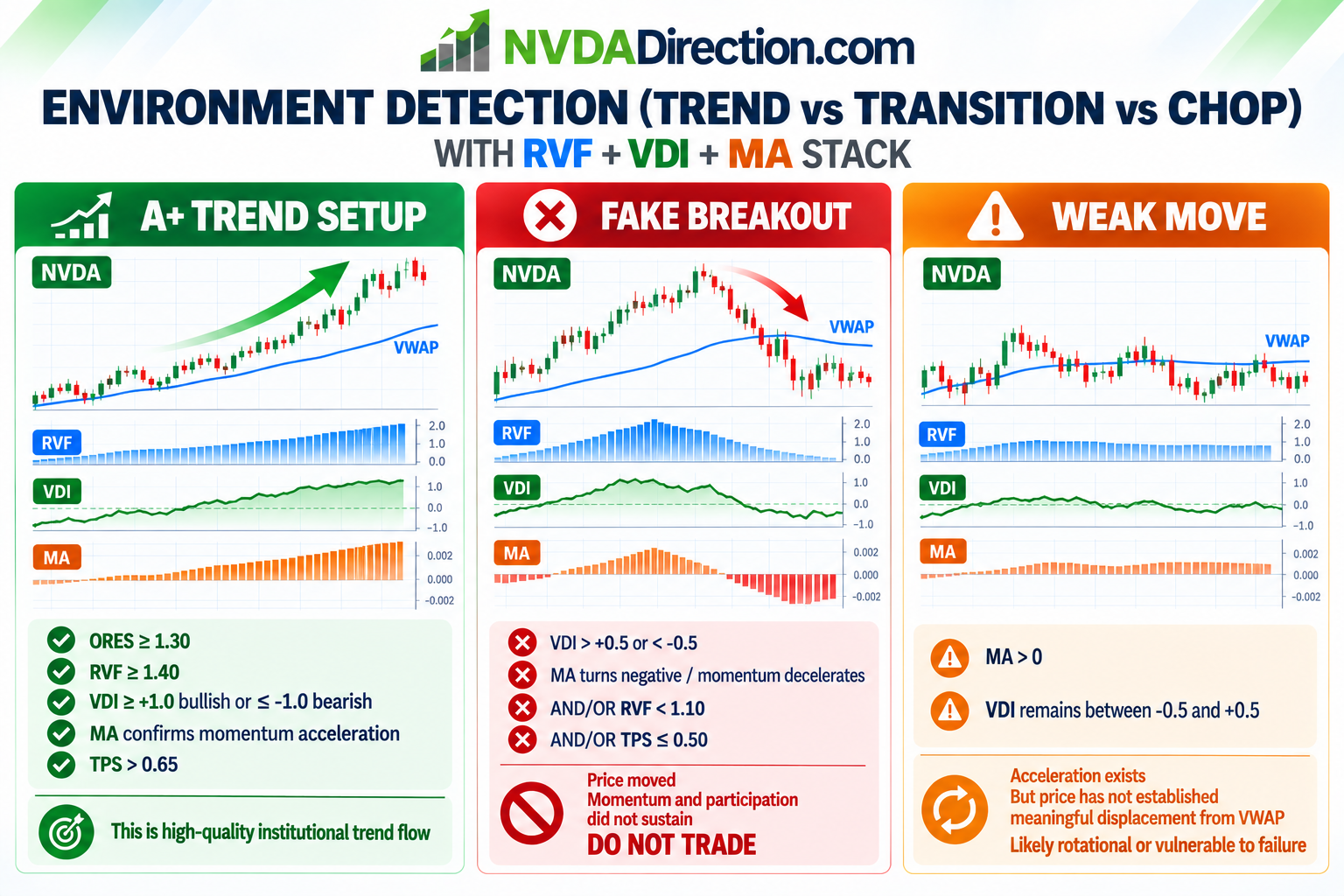
🔁 ENVIRONMENT DETECTION (TREND vs TRANSITION vs CHOP) WITH RVF + VDI + MA STACK
🔥 A+ TREND SETUP
ORES ≥ 1.30
AND
RVF ≥ 1.40
AND
VDI ≥ +1.0 bullish or ≤ -1.0 bearish
AND
MA confirms momentum acceleration
AND
TPS > 0.65
→ This is high-quality institutional trend flow
❌ FAKE BREAKOUT
VDI > +0.5 or < -0.5
BUT
MA turns negative / momentum decelerates
AND/OR
RVF < 1.10
AND/OR
TPS ≤ 0.50
→ Price moved
→ Momentum and participation did not sustain
👉 DO NOT TRADE
⚠️ WEAK MOVE
MA > 0
BUT
VDI remains between -0.5 and +0.5
→ Acceleration exists
→ But price has not established meaningful displacement from VWAP
👉 Likely rotational or vulnerable to failure
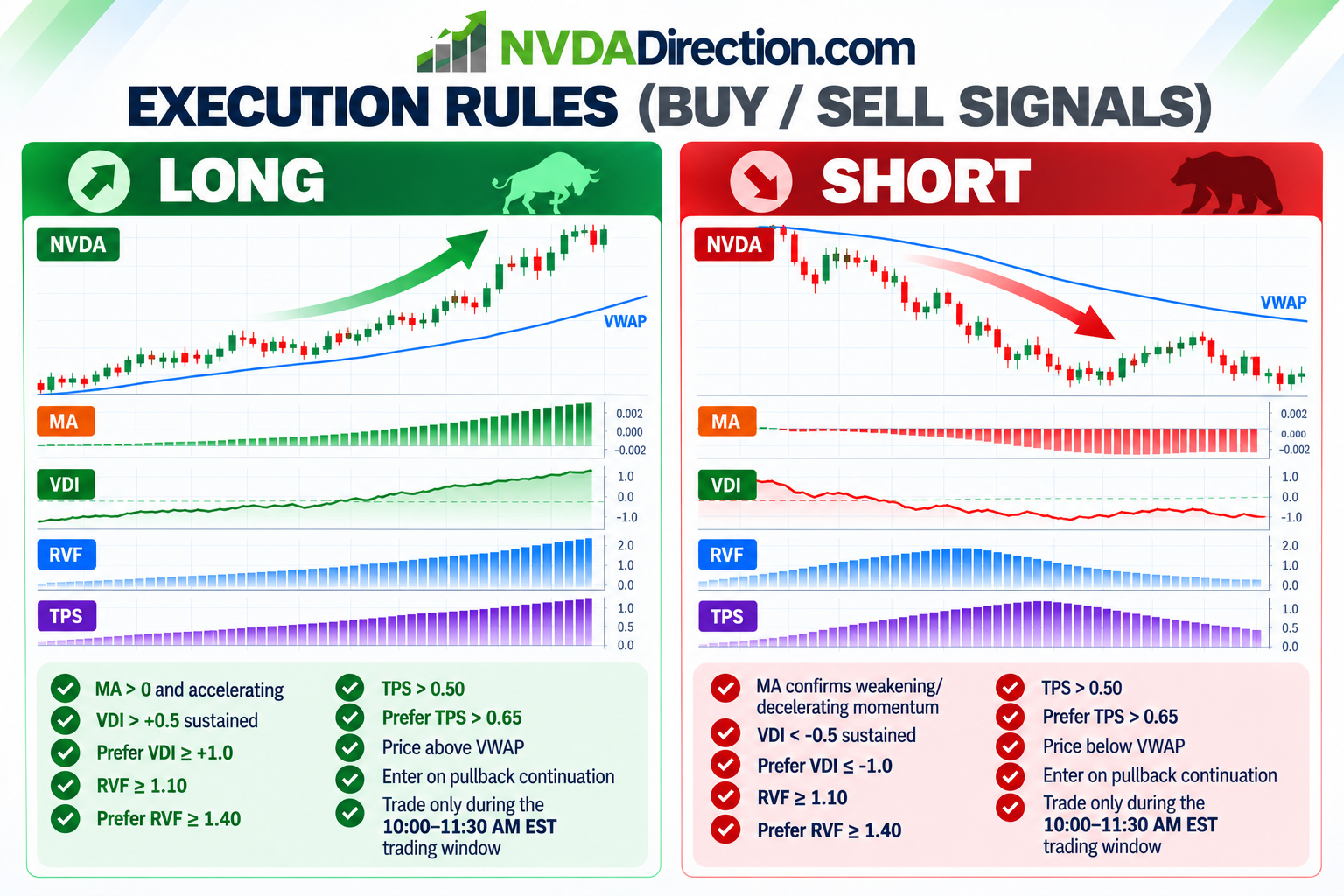
⚡ EXECUTION RULES (BUY / SELL SIGNALS)
LONG
-
MA > 0 and accelerating
-
VDI > +0.5 sustained
-
Prefer VDI ≥ +1.0
-
RVF ≥ 1.10
-
Prefer RVF ≥ 1.40
-
TPS > 0.50
-
Prefer TPS > 0.65
-
Price above VWAP
-
Enter on pullback continuation
-
Trade only during the 10:00–11:30 AM EST trading window
SHORT
-
MA confirms weakening/decelerating momentum
-
VDI < -0.5 sustained
-
Prefer VDI ≤ -1.0
-
RVF ≥ 1.10
-
Prefer RVF ≥ 1.40
-
TPS > 0.50
-
Prefer TPS > 0.65
-
Price below VWAP
-
Enter on pullback continuation
-
Trade only during the 10:00–11:30 AM EST trading window
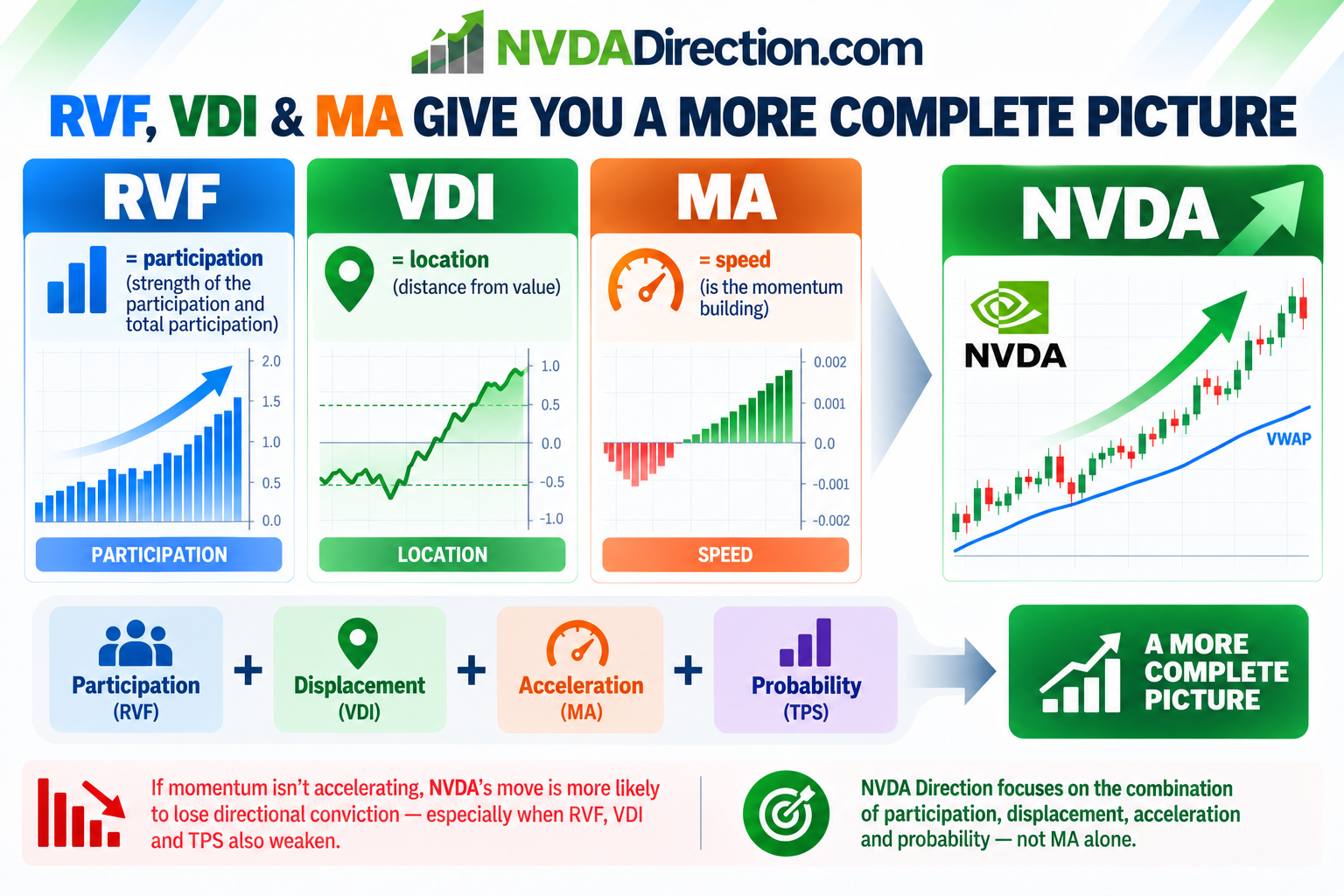
🧠 RVF, VDI & MA GIVE YOU A MORE COMPLETE PICTURE
-
RVF = participation (strength of the participation and total participation)
-
VDI = location (distance from value)
-
MA = speed (is the momentum building)
If momentum isn’t accelerating, NVDA’s move is more likely to lose directional conviction — especially when RVF, VDI and TPS also weaken.
NVDA Direction focuses on the combination of participation, displacement, acceleration and probability — not MA alone.