How to Pass Prop Firm Challenges with NVDA Direction Signals
Contact customer support at support@nvdadirection.com
How to Pass Prop Firm Challenges with NVDA Direction Signals
Contact customer support at support@nvdadirection.com
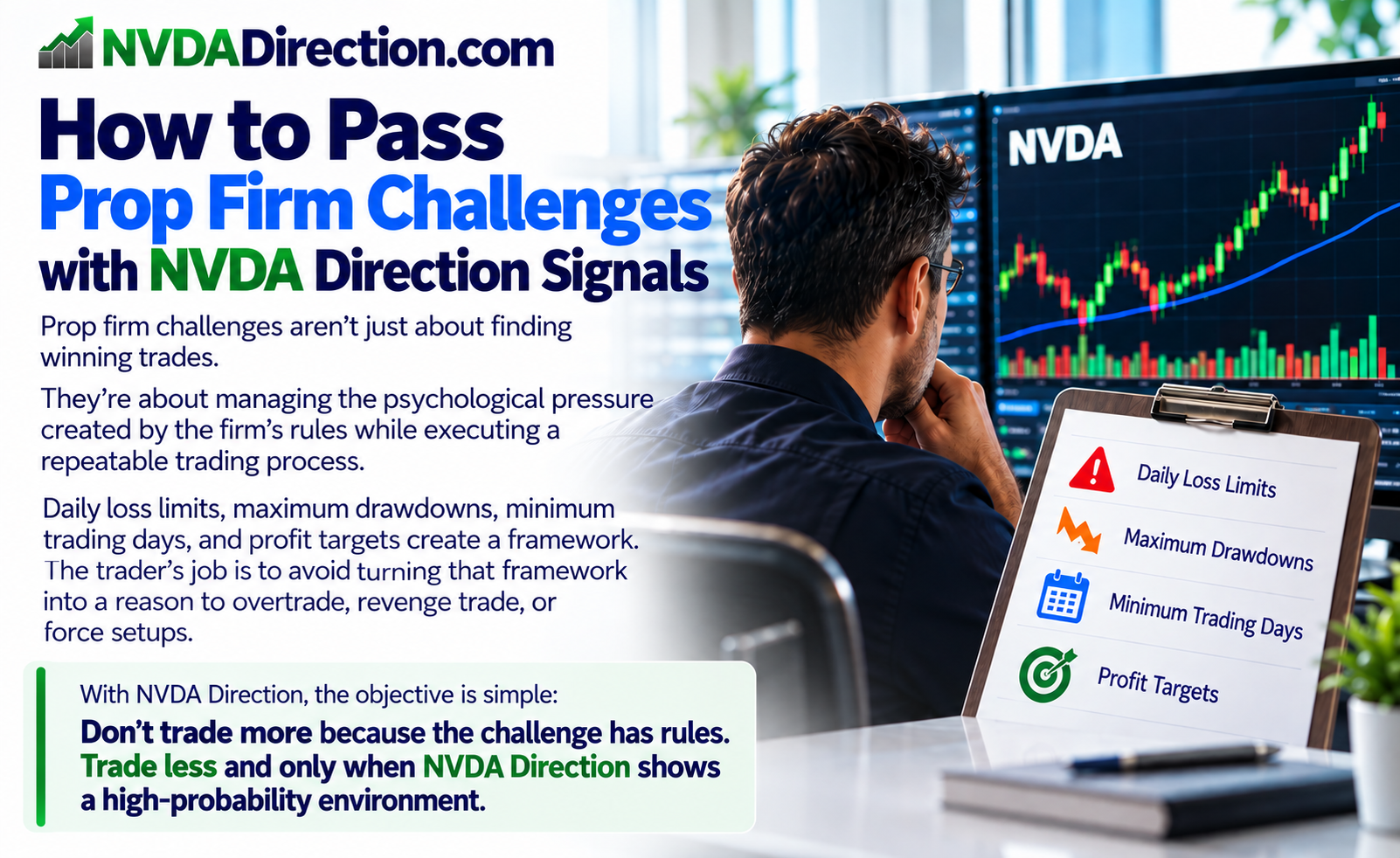
Prop firm challenges aren't just about finding winning trades.
They're about managing the psychological pressure created by the firm's rules while executing a repeatable trading process.
Daily loss limits, maximum drawdowns, minimum trading days, and profit targets create a framework. The trader's job is to avoid turning that framework into a reason to overtrade, revenge trade, or force setups.
With NVDA Direction, the objective is simple:
Don't trade more because the challenge has rules. Trade less and only when NVDA Direction shows a high-probability environment.
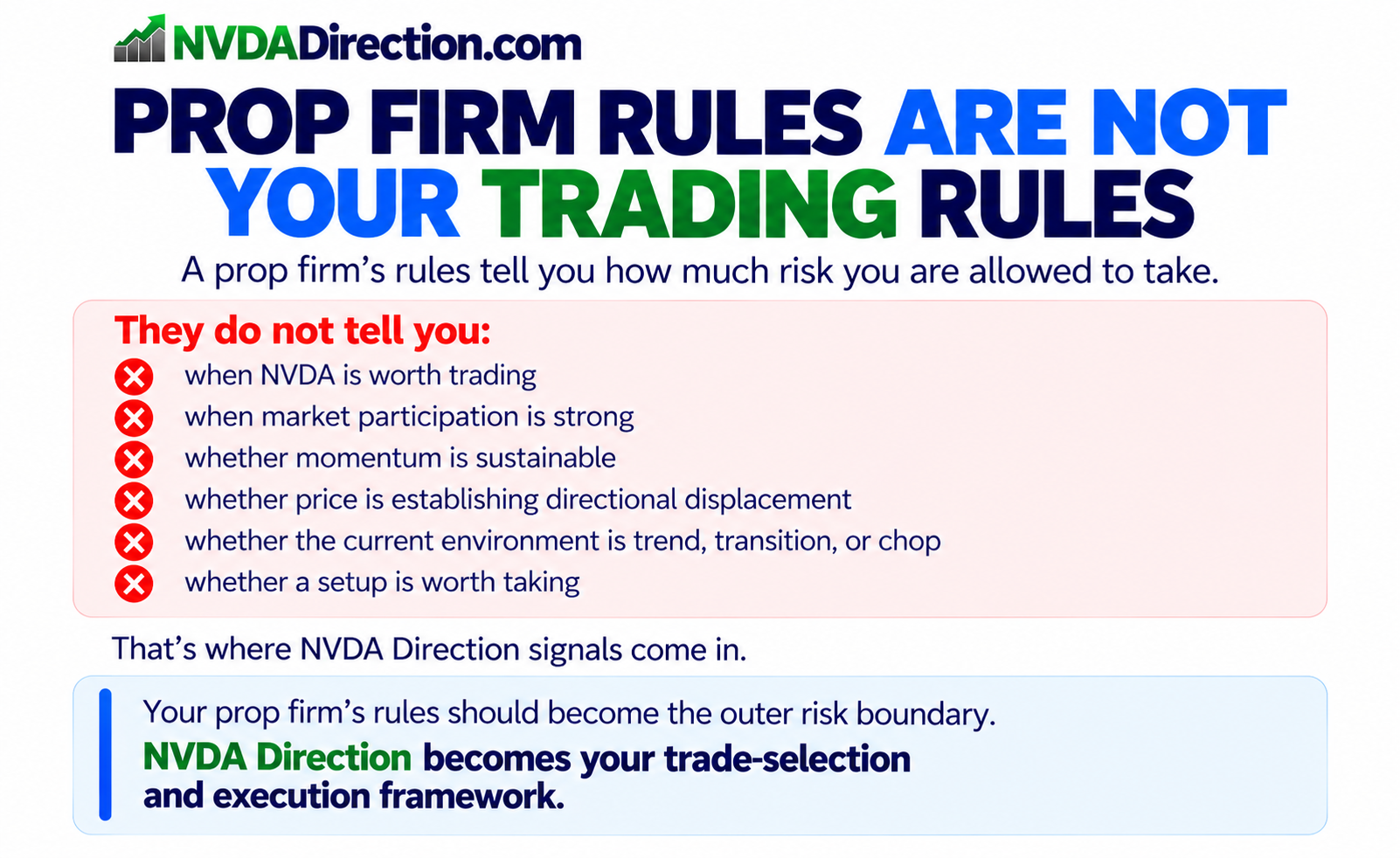
🧠 PROP FIRM RULES ARE NOT YOUR TRADING RULES
A prop firm's rules tell you how much risk you are allowed to take.
They do not tell you:
- when NVDA is worth trading
- when market participation is strong
- whether momentum is sustainable
- whether price is establishing directional displacement
- whether the current environment is trend, transition, or chop
- whether a setup is worth taking
That's where NVDA Direction signals come in.
Your prop firm's rules should become the outer risk boundary.
NVDA Direction becomes your trade-selection and execution framework.
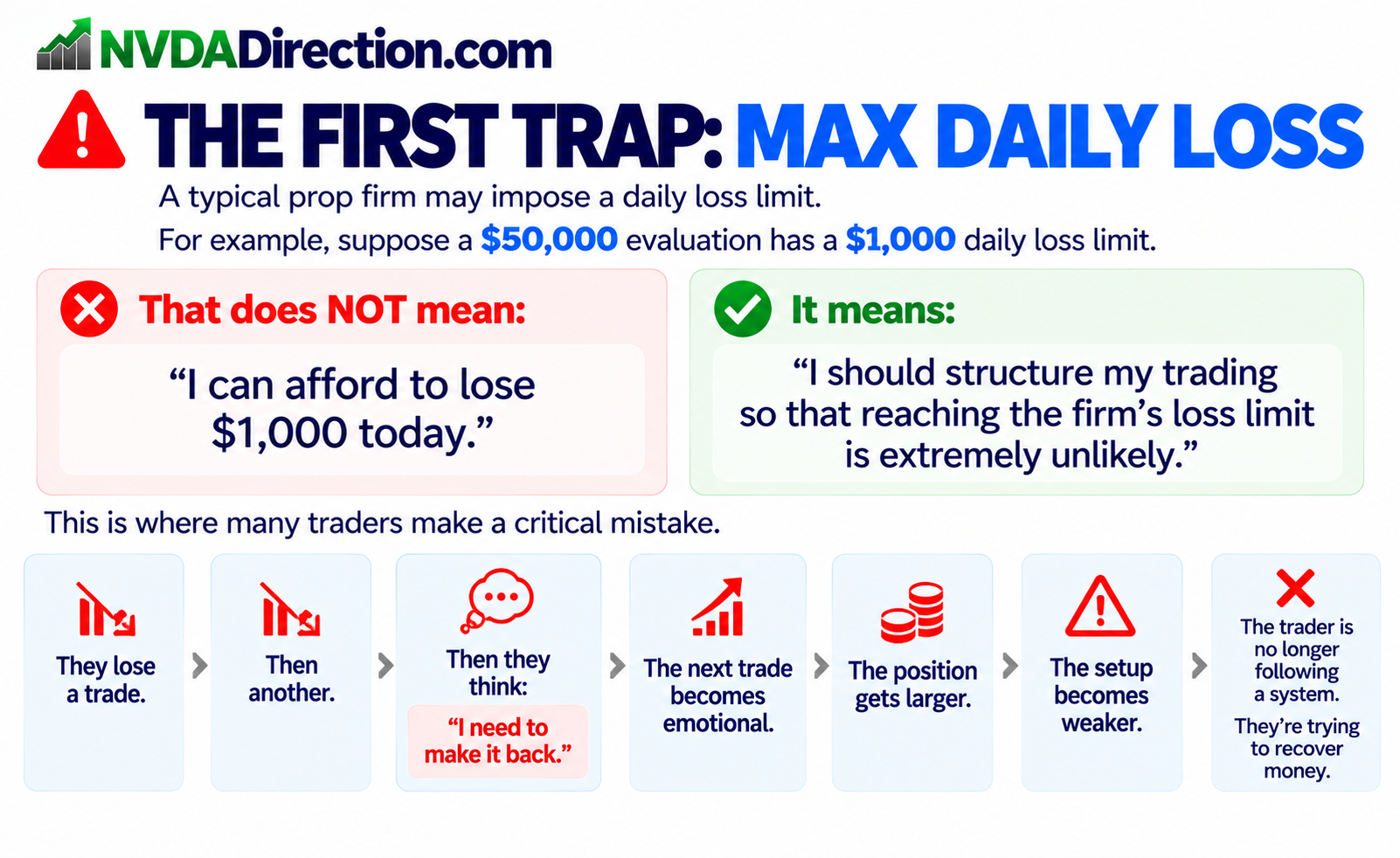
⚠️ THE FIRST TRAP: MAX DAILY LOSS
A typical prop firm may impose a daily loss limit.
For example, suppose a $50,000 evaluation has a $1,000 daily loss limit.
That does NOT mean:
"I can afford to lose $1,000 today."
It means:
"I should structure my trading so that reaching the firm's loss limit is extremely unlikely."
This is where many traders make a critical mistake.
They lose a trade.
Then another.
Then they think:
"I need to make it back."
The next trade becomes emotional.
The position gets larger.
The setup becomes weaker.
The trader is no longer following a system.
They're trying to recover money.
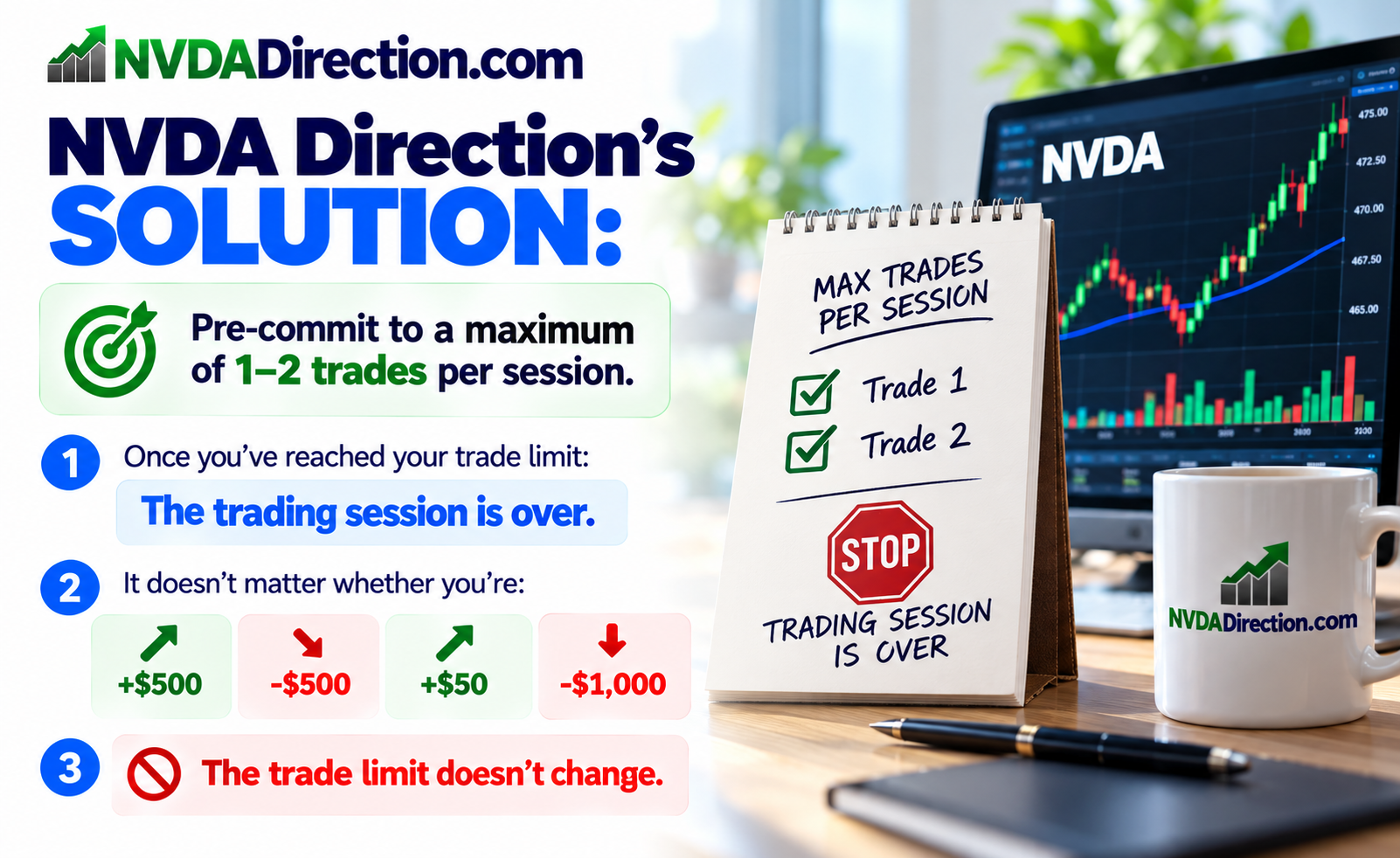
NVDA Direction's solution:
Pre-commit to a maximum of 1–2 trades per session.
Once you've reached your trade limit:
The trading session is over.
It doesn't matter whether you're:
- +$500
- -$500
- +$50
- -$1,000
The trade limit doesn't change.
🎯 YOUR TRADE COUNT IS A RISK CONTROL
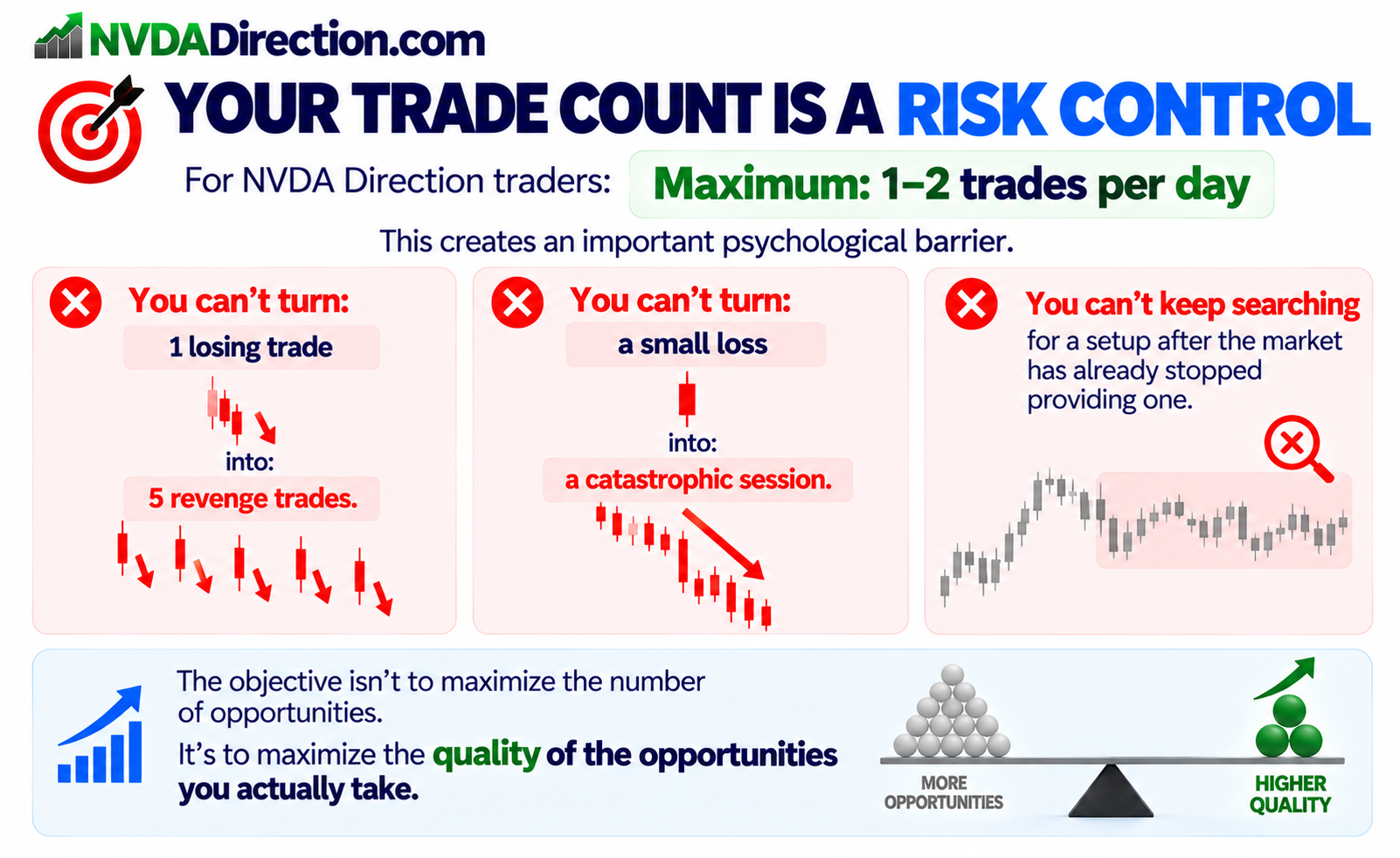
For NVDA Direction traders:
Maximum: 1–2 trades per day
This creates an important psychological barrier.
You can't turn:
1 losing trade
into:
5 revenge trades.
You can't turn:
a small loss
into:
a catastrophic session.
You can't keep searching for a setup after the market has already stopped providing one.
The objective isn't to maximize the number of opportunities.
It's to maximize the quality of the opportunities you actually take.
⚡ THE SECOND TRAP: OVERTRADING THE DRAWdown
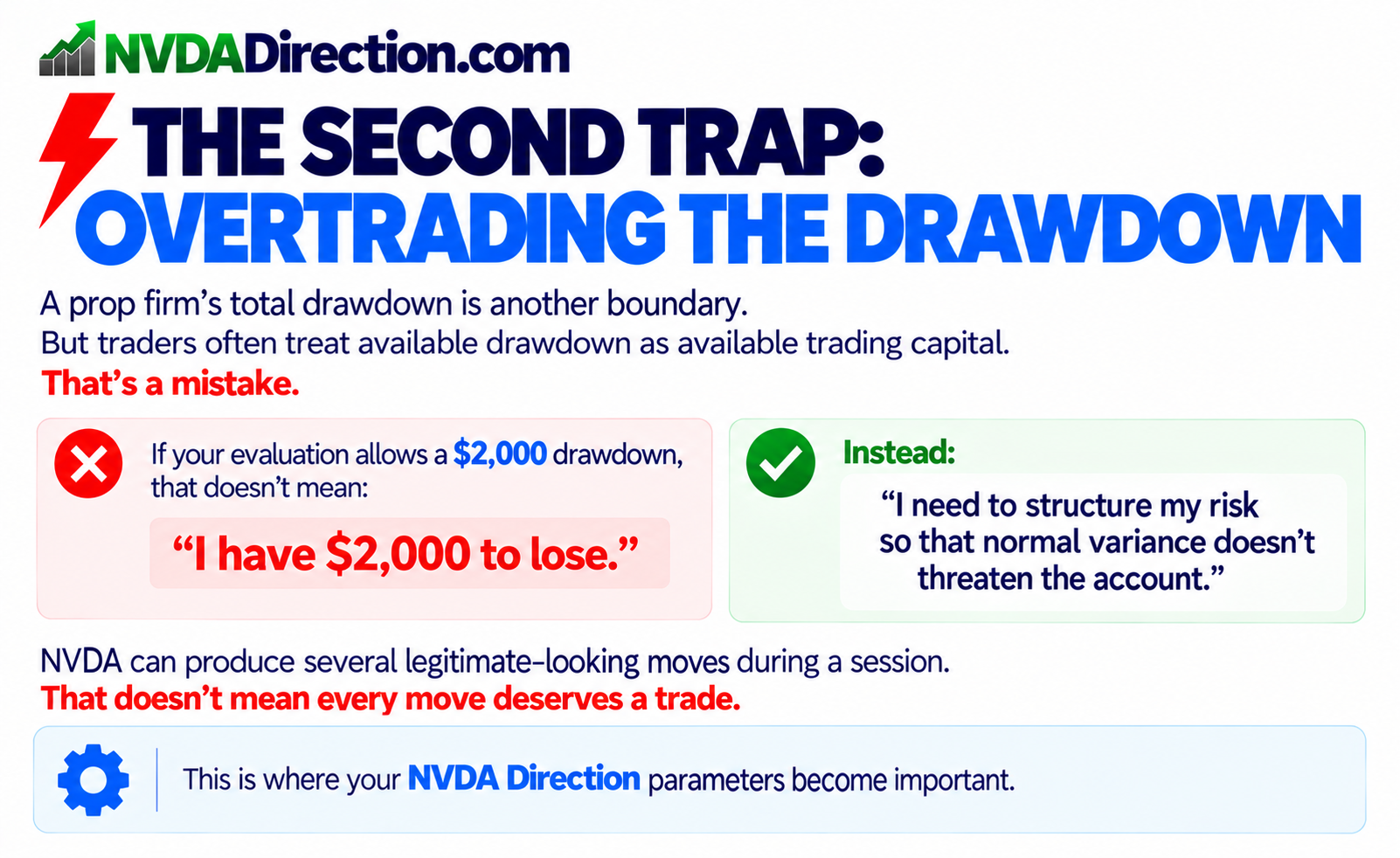
A prop firm's total drawdown is another boundary.
But traders often treat available drawdown as available trading capital.
That's a mistake.
If your evaluation allows a $2,000 drawdown, that doesn't mean:
"I have $2,000 to lose."
Instead:
"I need to structure my risk so that normal variance doesn't threaten the account."
NVDA can produce several legitimate-looking moves during a session.
That doesn't mean every move deserves a trade.
This is where your NVDA Direction parameters become important.
🧠 ONLY TRADE WHEN THE ENVIRONMENT SUPPORTS THE SIGNAL
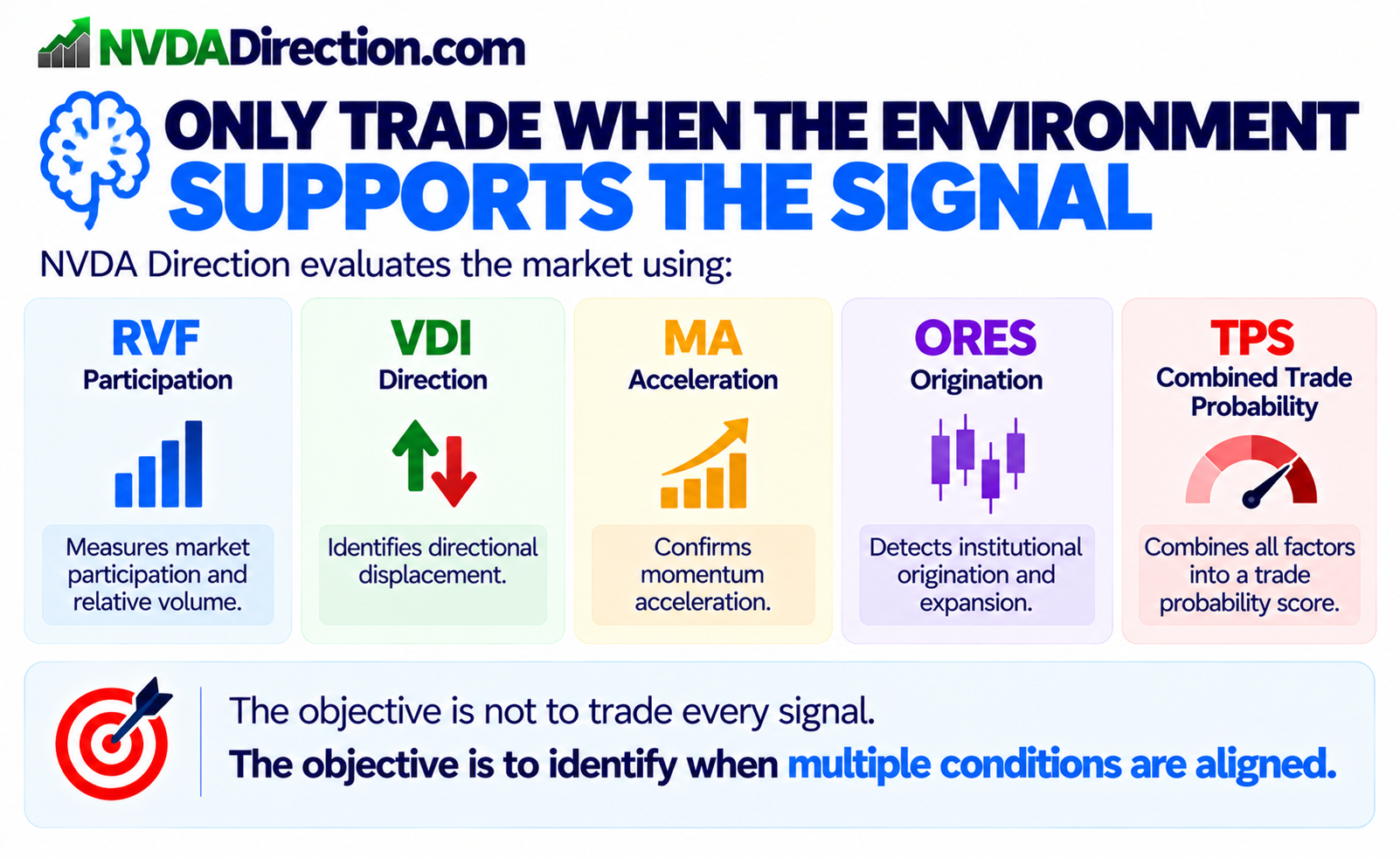
NVDA Direction evaluates the market using:
- RVF → participation
- VDI → direction
- MA → acceleration
- ORES → origination
- TPS → combined trade probability
The objective is not to trade every signal.
The objective is to identify when multiple conditions are aligned.
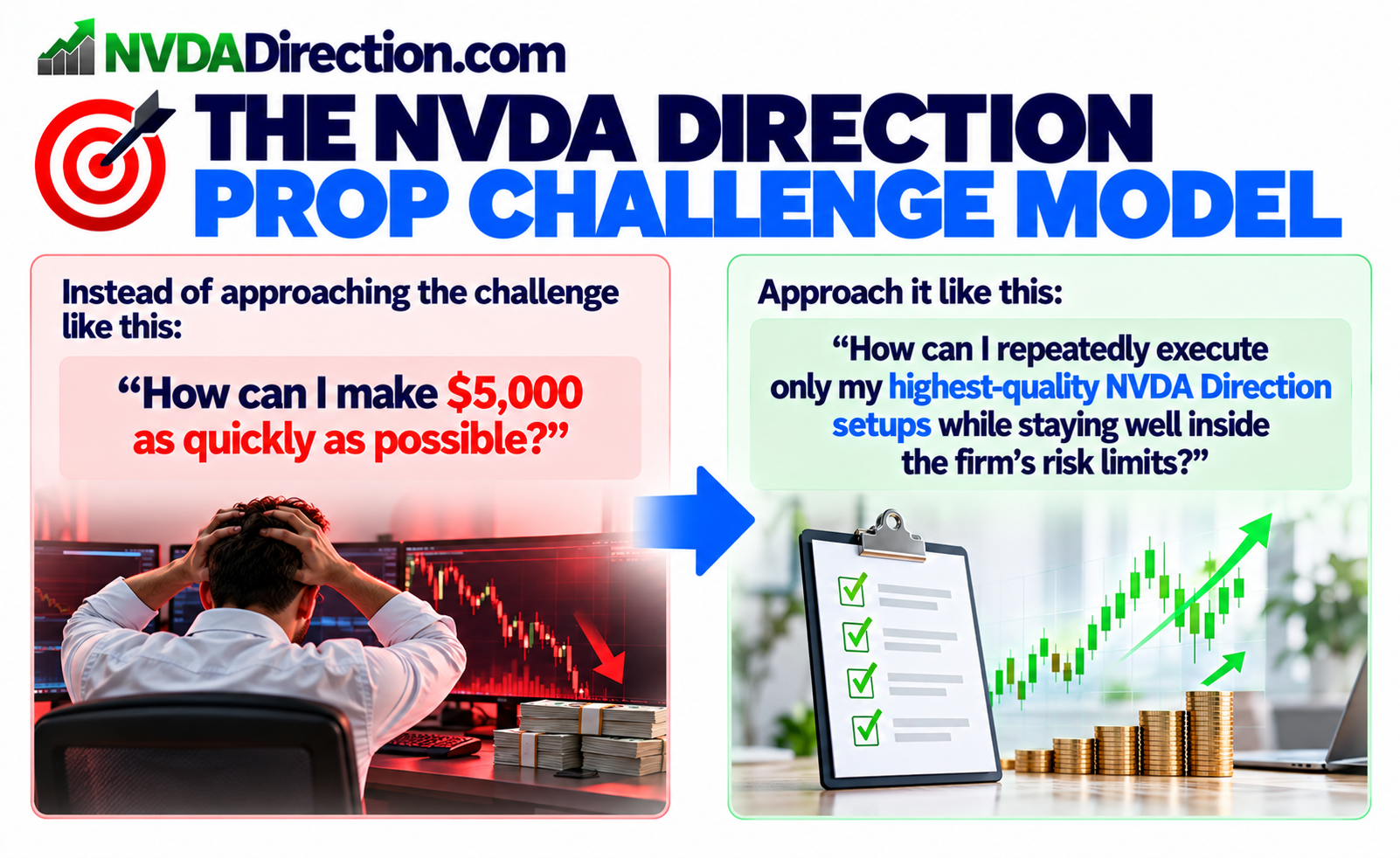
🎯 THE NVDA DIRECTION PROP CHALLENGE MODEL
Instead of approaching the challenge like this:
"How can I make $5,000 as quickly as possible?"
Approach it like this:
"How can I repeatedly execute only my highest-quality NVDA Direction setups while staying well inside the firm's risk limits?"
That changes everything.
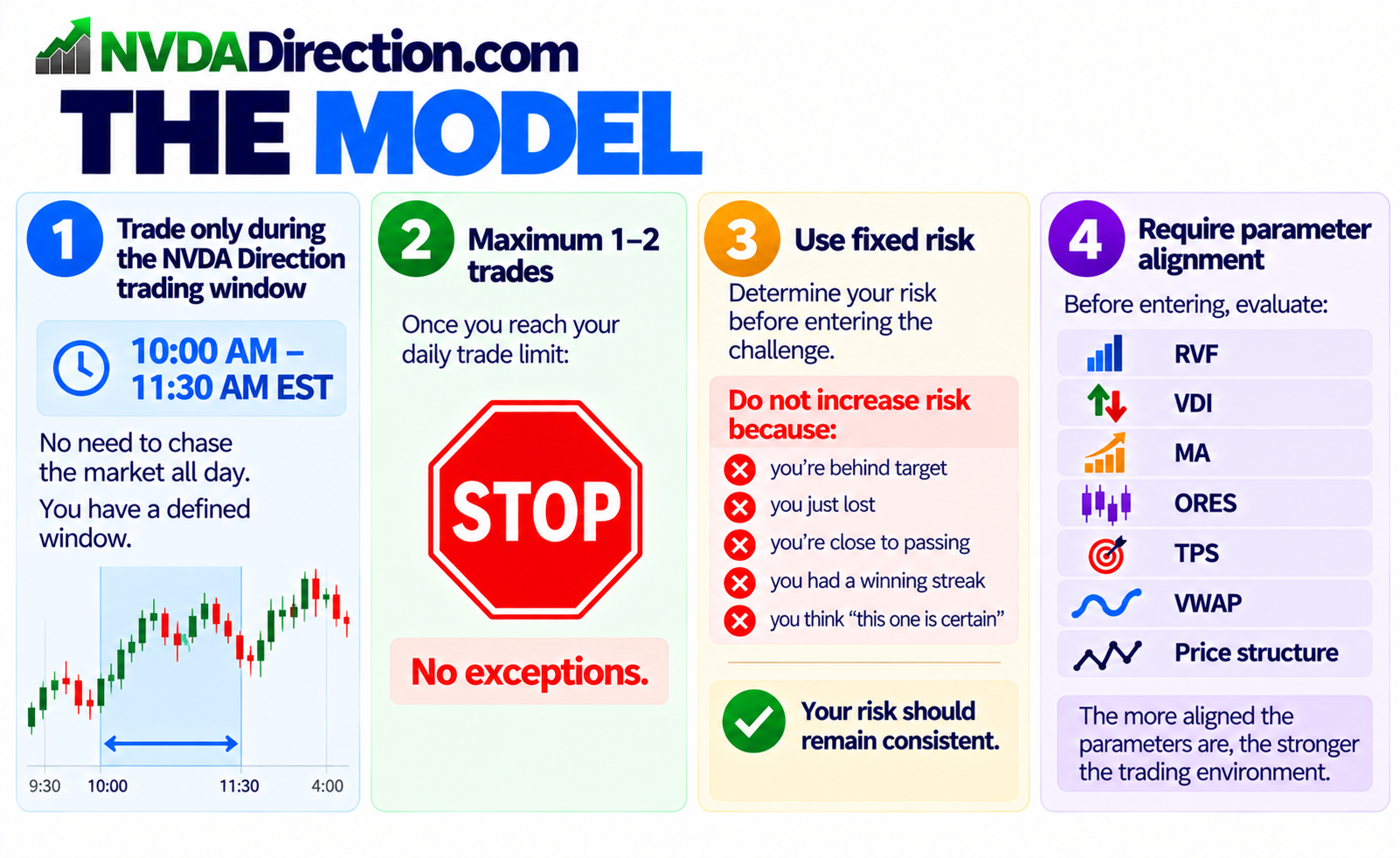
THE MODEL
1. Trade only during the NVDA Direction trading window
10:00 AM – 11:30 AM EST
No need to chase the market all day.
You have a defined window.
2. Maximum 1–2 trades
Once you reach your daily trade limit:
STOP.
No exceptions.
3. Use fixed risk
Determine your risk before entering the challenge.
Do not increase risk because:
- you're behind target
- you just lost
- you're close to passing
- you had a winning streak
- you think "this one is certain"
Your risk should remain consistent.
4. Require parameter alignment
Before entering, evaluate:
RVF
VDI
MA
ORES
TPS
VWAP
Price structure
The more aligned the parameters are, the stronger the trading environment.
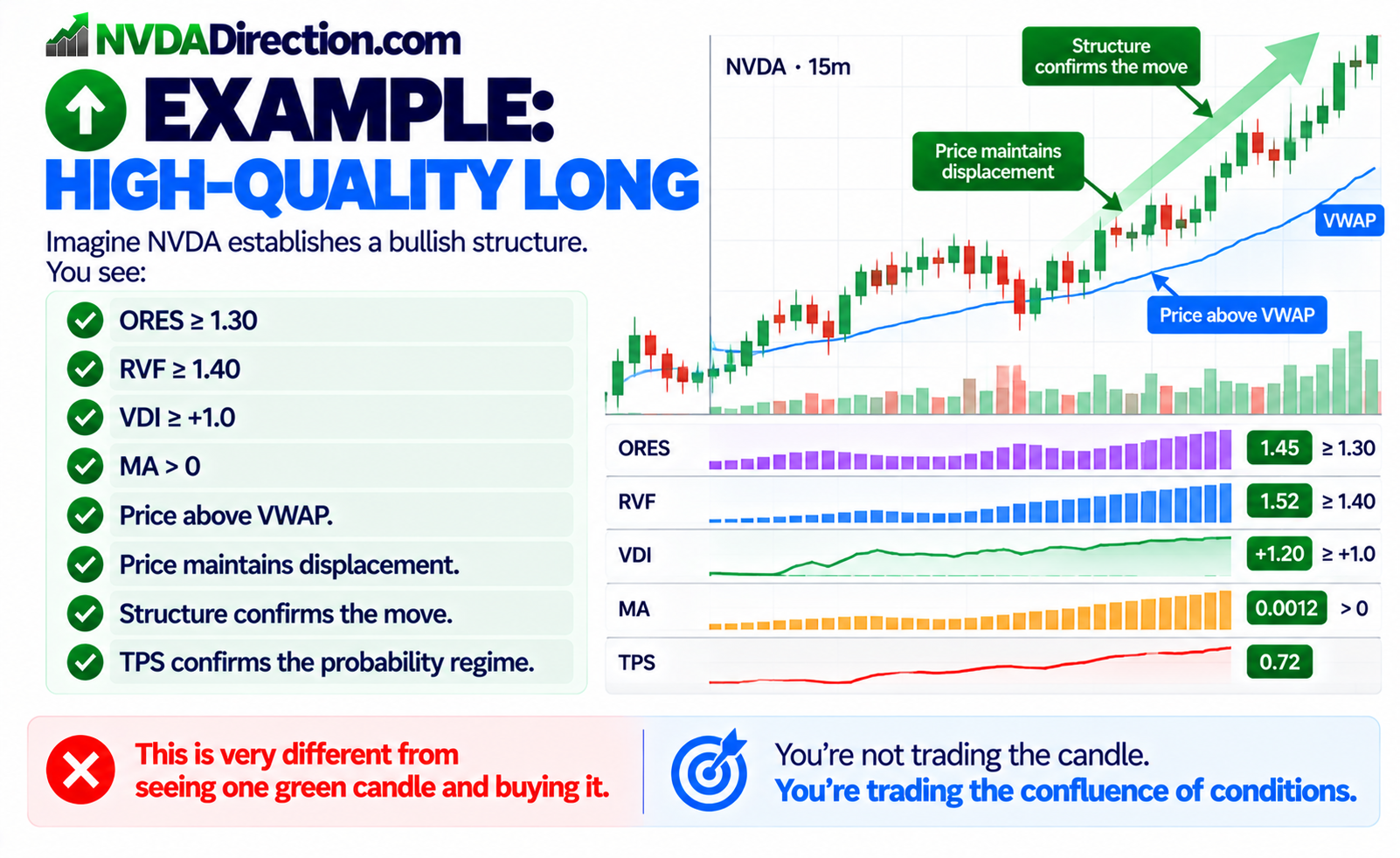
🟢 EXAMPLE: HIGH-QUALITY LONG
Imagine NVDA establishes a bullish structure.
You see:
ORES ≥ 1.30
RVF ≥ 1.40
VDI ≥ +1.0
MA > 0
Price above VWAP.
Price maintains displacement.
Structure confirms the move.
TPS confirms the probability regime.
This is very different from seeing one green candle and buying it.
You're not trading the candle.
You're trading the confluence of conditions.
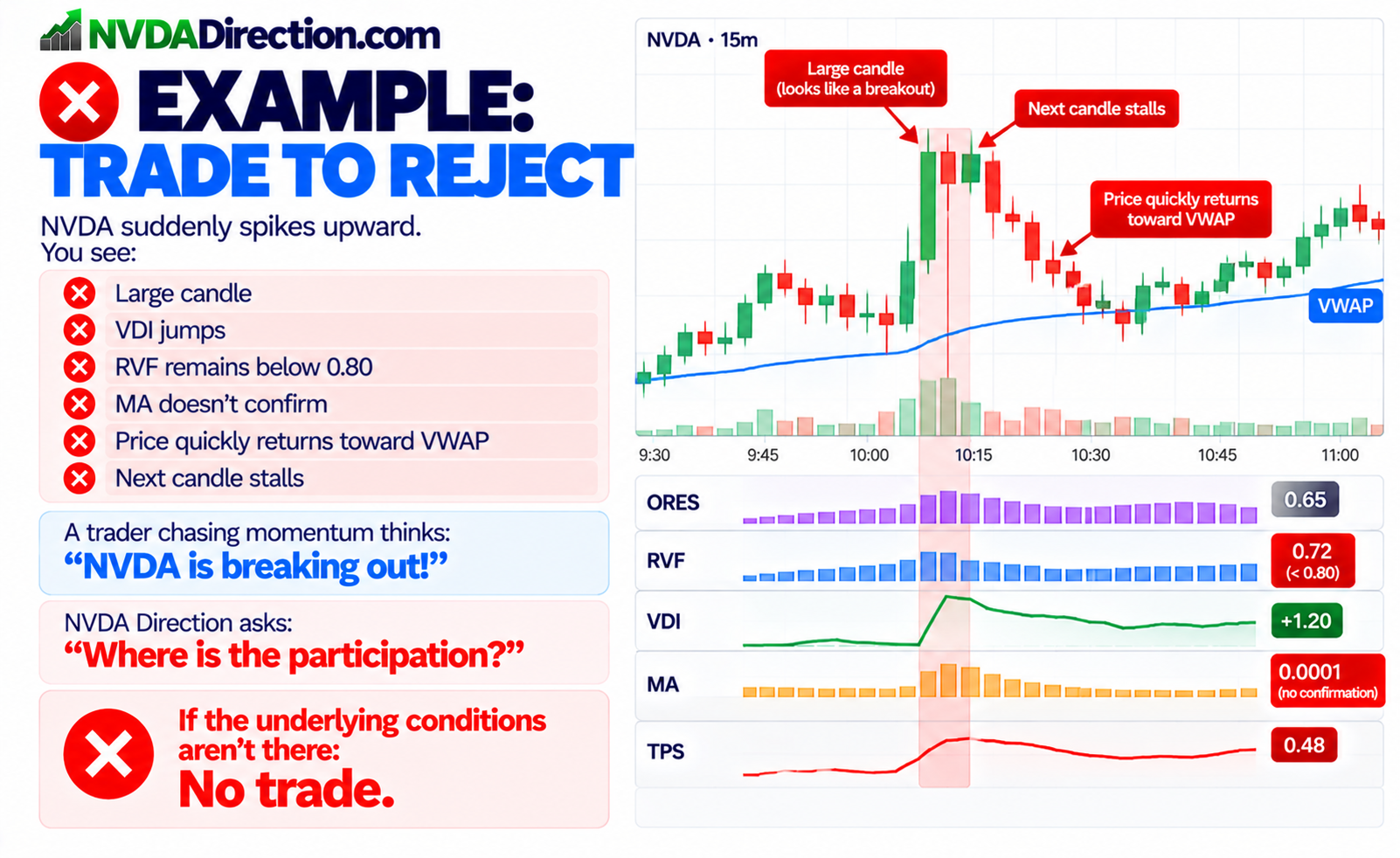
🔴 EXAMPLE: TRADE TO REJECT
NVDA suddenly spikes upward.
You see:
- Large candle
- VDI jumps
- RVF remains below 0.80
- MA doesn't confirm
- Price quickly returns toward VWAP
- Next candle stalls
A trader chasing momentum thinks:
"NVDA is breaking out!"
NVDA Direction asks:
"Where is the participation?"
If the underlying conditions aren't there:
No trade.
🧠 THE THIRD TRAP: FORCED TRADING
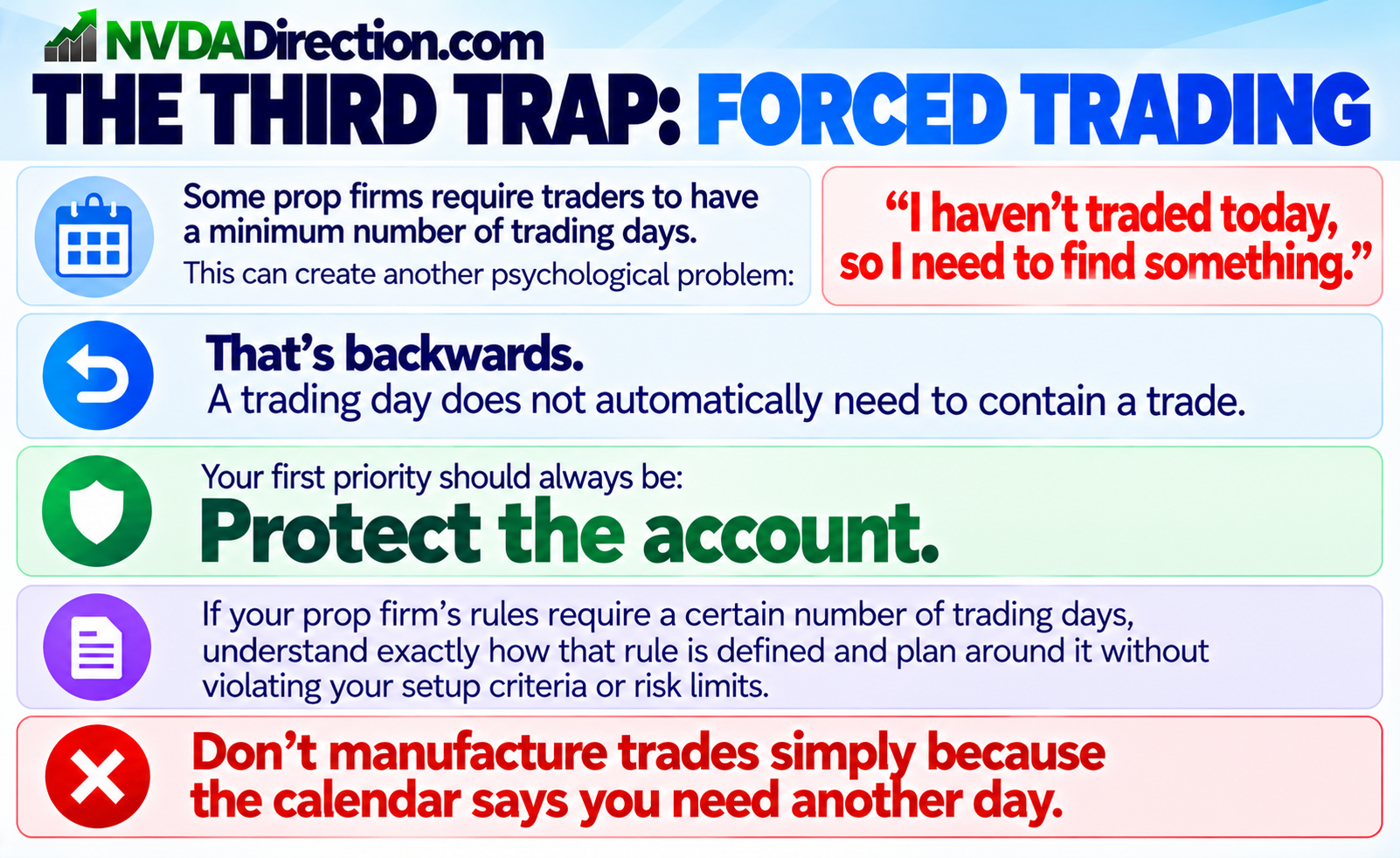
Some prop firms require traders to have a minimum number of trading days.
This can create another psychological problem:
"I haven't traded today, so I need to find something."
That's backwards.
A trading day does not automatically need to contain a trade.
Your first priority should always be:
Protect the account.
If your prop firm's rules require a certain number of trading days, understand exactly how that rule is defined and plan around it without violating your setup criteria or risk limits.
Don't manufacture trades simply because the calendar says you need another day.
🛡️ THE NVDA DIRECTION ANTI-REVENGE PROTOCOL
Here's the rule set:
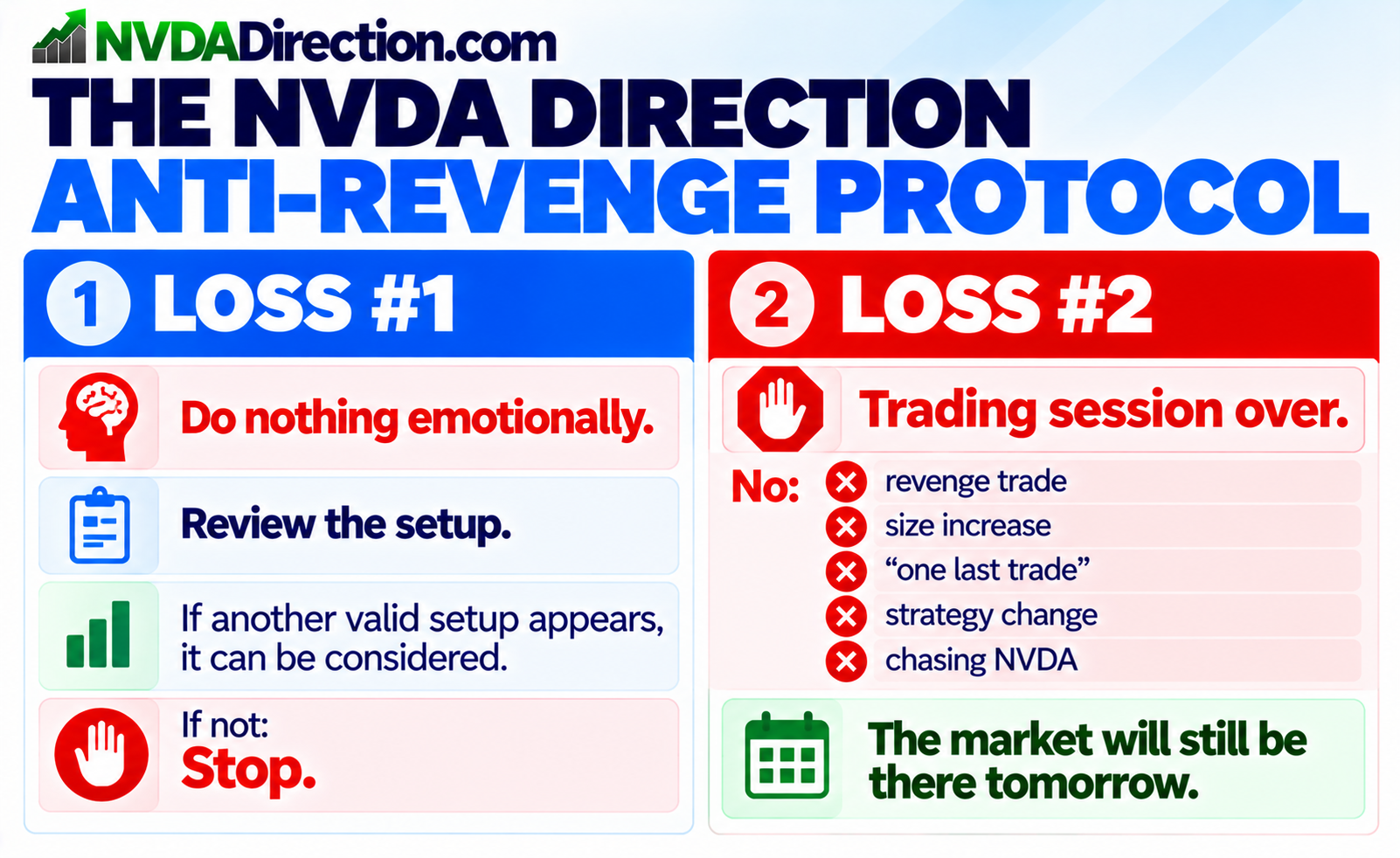
LOSS #1
Do nothing emotionally.
Review the setup.
If another valid setup appears, it can be considered.
If not:
Stop.
LOSS #2
Trading session over.
No:
- revenge trade
- size increase
- "one last trade"
- strategy change
- chasing NVDA
The market will still be there tomorrow.
💰 DON'T TRY TO WIN THE CHALLENGE IN ONE DAY
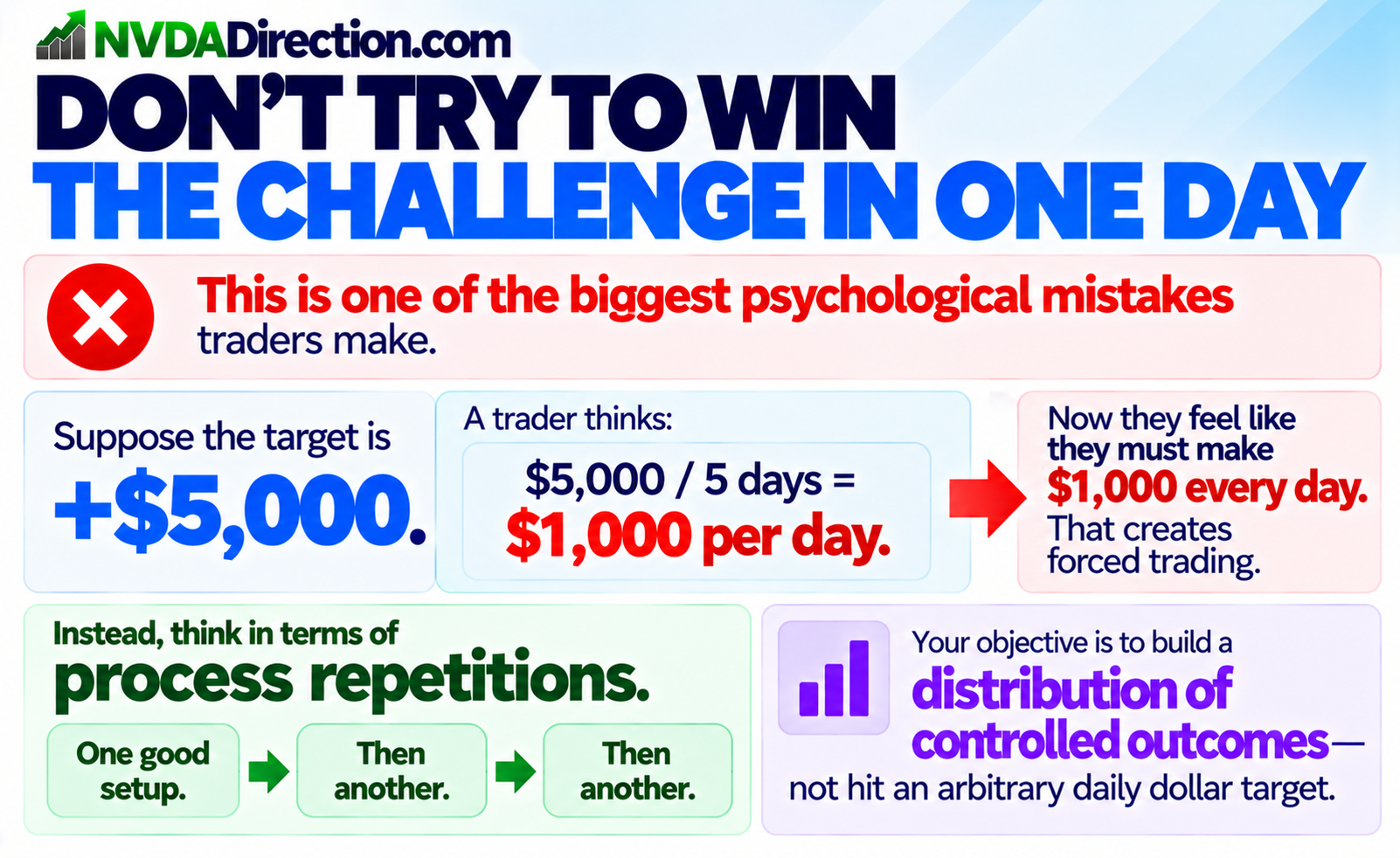
This is one of the biggest psychological mistakes traders make.
Suppose the target is +$5,000.
A trader thinks:
"$5,000 / 5 days = $1,000 per day."
Now they feel like they must make $1,000 every day.
That creates forced trading.
Instead, think in terms of process repetitions.
One good setup.
Then another.
Then another.
Your objective is to build a distribution of controlled outcomes, not hit an arbitrary daily dollar target.
📈 LET THE MATH WORK FOR YOU
Suppose your predefined risk is 0.5% per trade.
With a maximum of 2 trades per day:
Maximum planned loss from two full-risk losses:
-1.0%
That's dramatically different from a trader who takes:
- 5 trades
- 8 trades
- 12 trades
- increasing position size after losses
The biggest advantage isn't that NVDA Direction eliminates losing trades.
It doesn't.
The advantage is that losing trades are contained within a predefined process.

🔥 THE BORING TRADER WINS
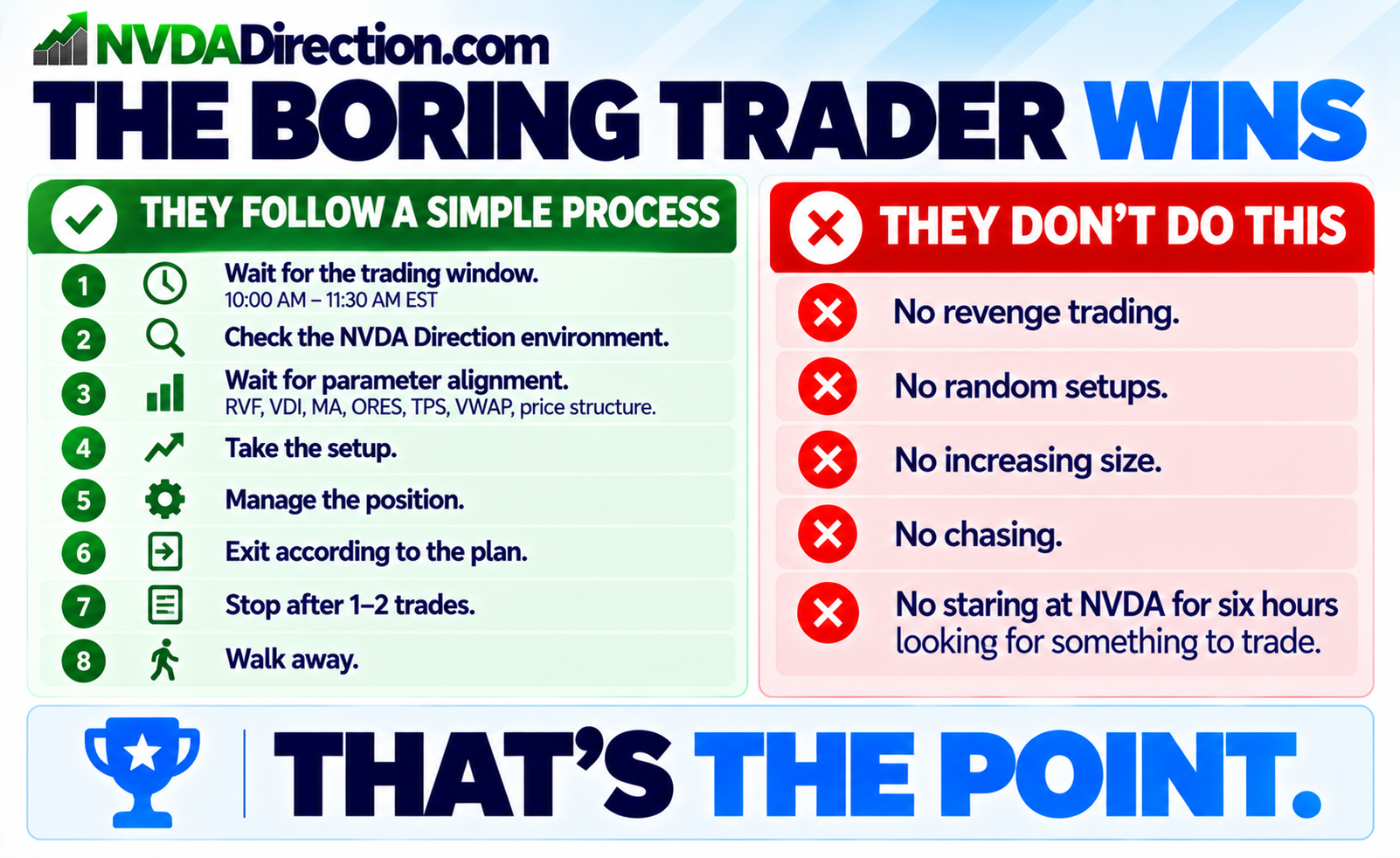
The best prop challenge trader may look remarkably boring.
They:
- Wait for the trading window.
- Check the NVDA Direction environment.
- Wait for parameter alignment.
- Take the setup.
- Manage the position.
- Exit according to the plan.
- Stop after 1–2 trades.
- Walk away.
No revenge trading.
No random setups.
No increasing size.
No chasing.
No staring at NVDA for six hours looking for something to trade.
That's the point.
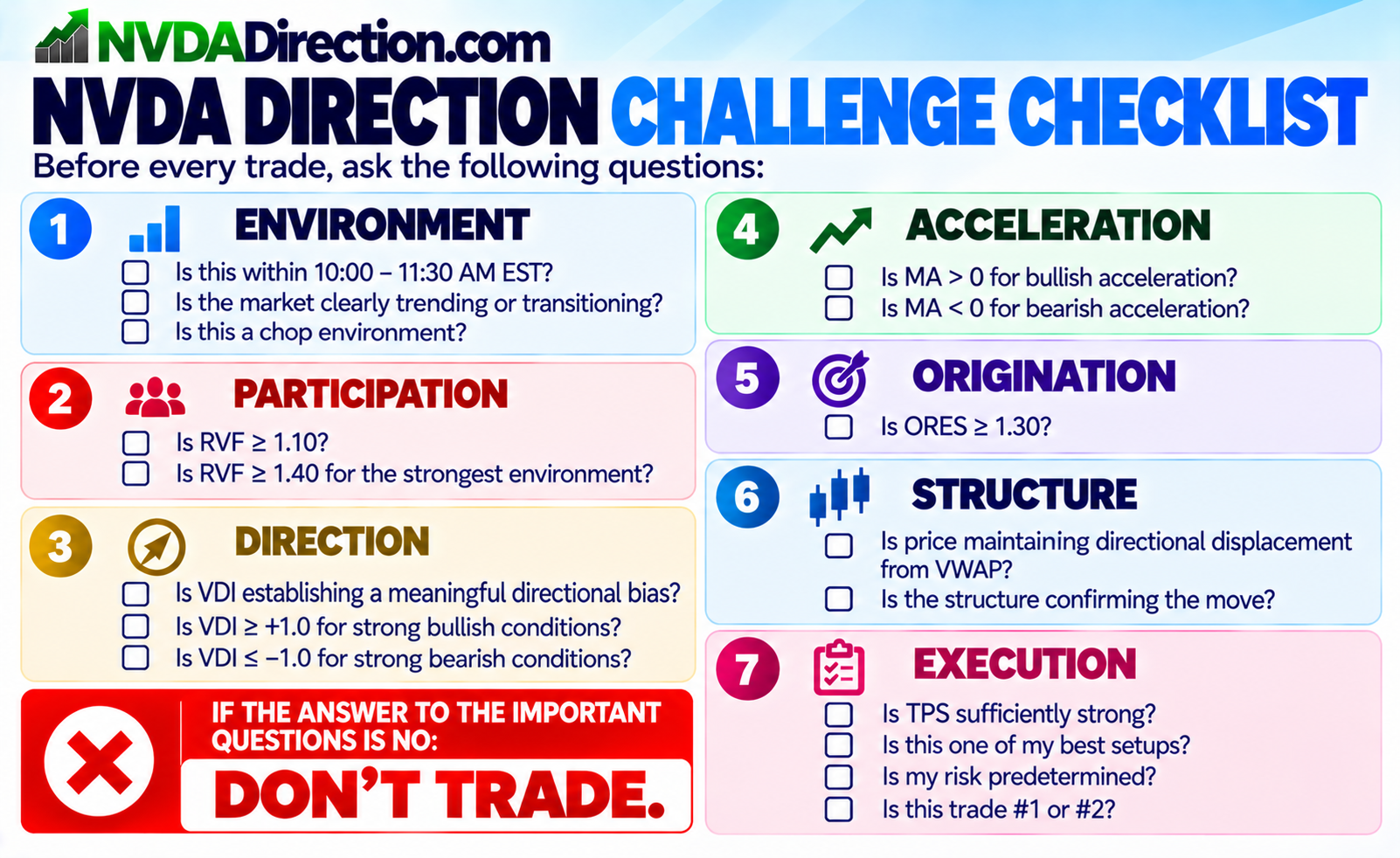
🧠 NVDA DIRECTION CHALLENGE CHECKLIST
Before every trade, ask:
ENVIRONMENT
☐ Is this within 10:00–11:30 AM EST?
☐ Is the market clearly trending or transitioning?
☐ Is this a chop environment?
PARTICIPATION
☐ Is RVF ≥ 1.10?
☐ Is RVF ≥ 1.40 for the strongest environment?
DIRECTION
☐ Is VDI establishing a meaningful directional bias?
☐ Is VDI ≥ +1.0 for strong bullish conditions?
☐ Is VDI ≤ -1.0 for strong bearish conditions?
ACCELERATION
☐ Is MA > 0 for bullish acceleration?
☐ Is MA < 0 for bearish acceleration?
ORIGINATION
☐ Is ORES ≥ 1.30?
STRUCTURE
☐ Is price maintaining directional displacement from VWAP?
☐ Is the structure confirming the move?
EXECUTION
☐ Is TPS sufficiently strong?
☐ Is this one of my best setups?
☐ Is my risk predetermined?
☐ Is this trade #1 or #2?
If the answer to the important questions is no:
Don't trade.
🚨 THE BIGGEST PROP FIRM MISTAKE
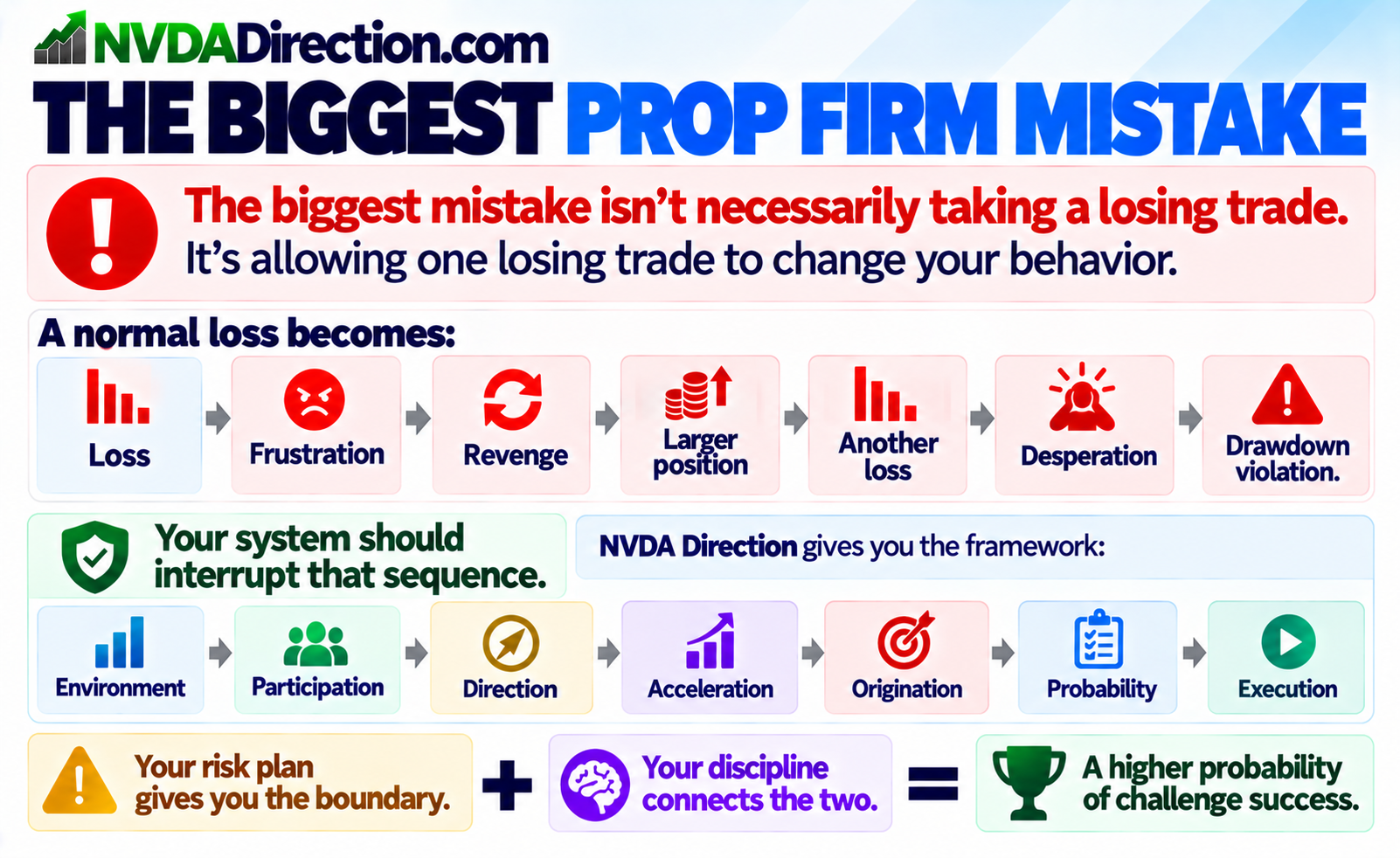
The biggest mistake isn't necessarily taking a losing trade.
It's allowing one losing trade to change your behavior.
A normal loss becomes:
Loss → frustration → revenge → larger position → another loss → desperation → drawdown violation.
Your system should interrupt that sequence.
NVDA Direction gives you the framework:
Environment → Participation → Direction → Acceleration → Origination → Probability → Execution
Your risk plan gives you the boundary.
Your discipline connects the two.
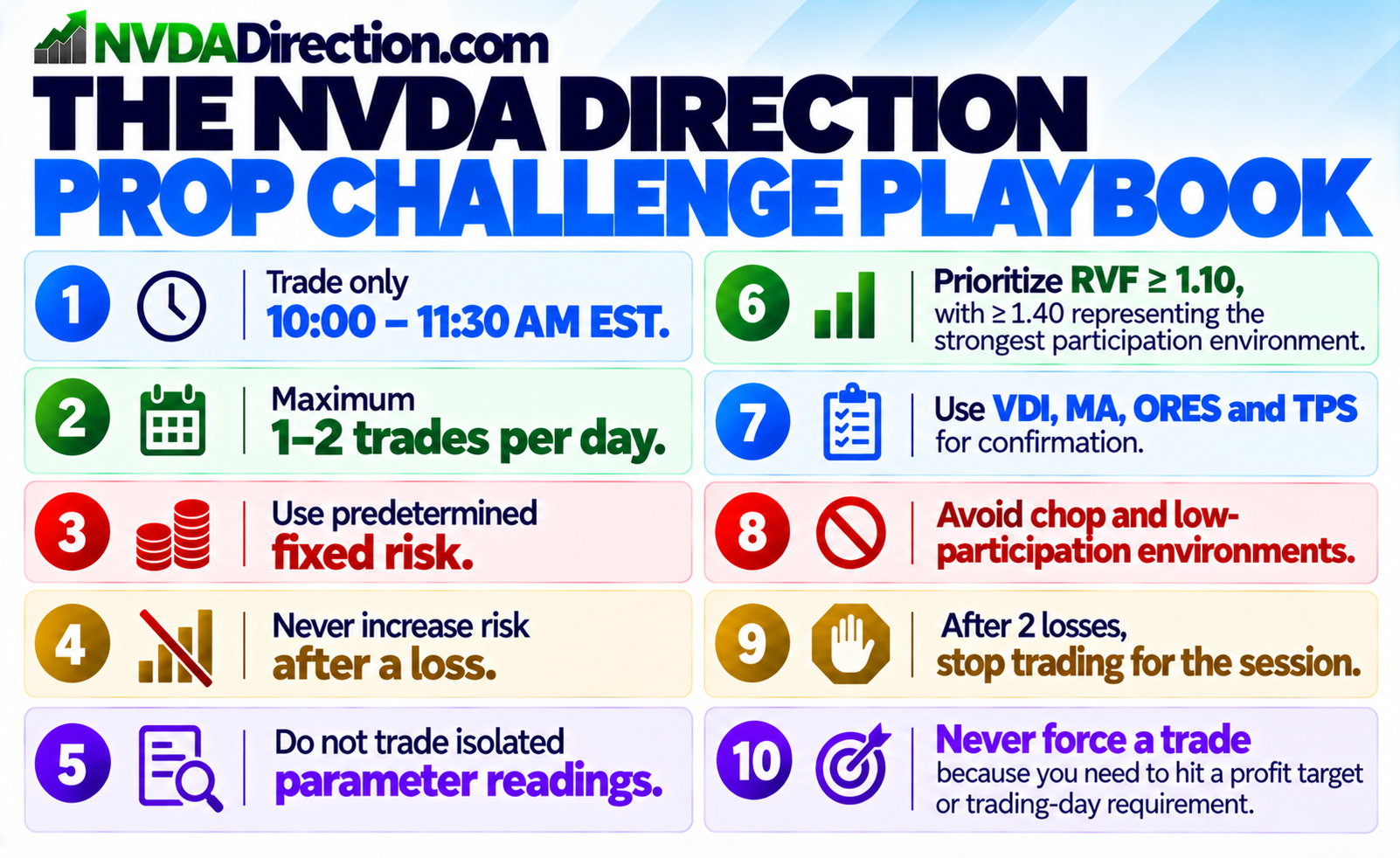
🏆 THE NVDA DIRECTION PROP CHALLENGE PLAYBOOK
RULE 1
Trade only 10:00–11:30 AM EST.
RULE 2
Maximum 1–2 trades per day.
RULE 3
Use predetermined fixed risk.
RULE 4
Never increase risk after a loss.
RULE 5
Do not trade isolated parameter readings.
RULE 6
Prioritize RVF ≥ 1.10, with ≥1.40 representing the strongest participation environment.
RULE 7
Use VDI, MA, ORES and TPS for confirmation.
RULE 8
Avoid chop and low-participation environments.
RULE 9
After 2 losses, stop trading for the session.
RULE 10
Never force a trade because you need to hit a profit target or trading-day requirement.
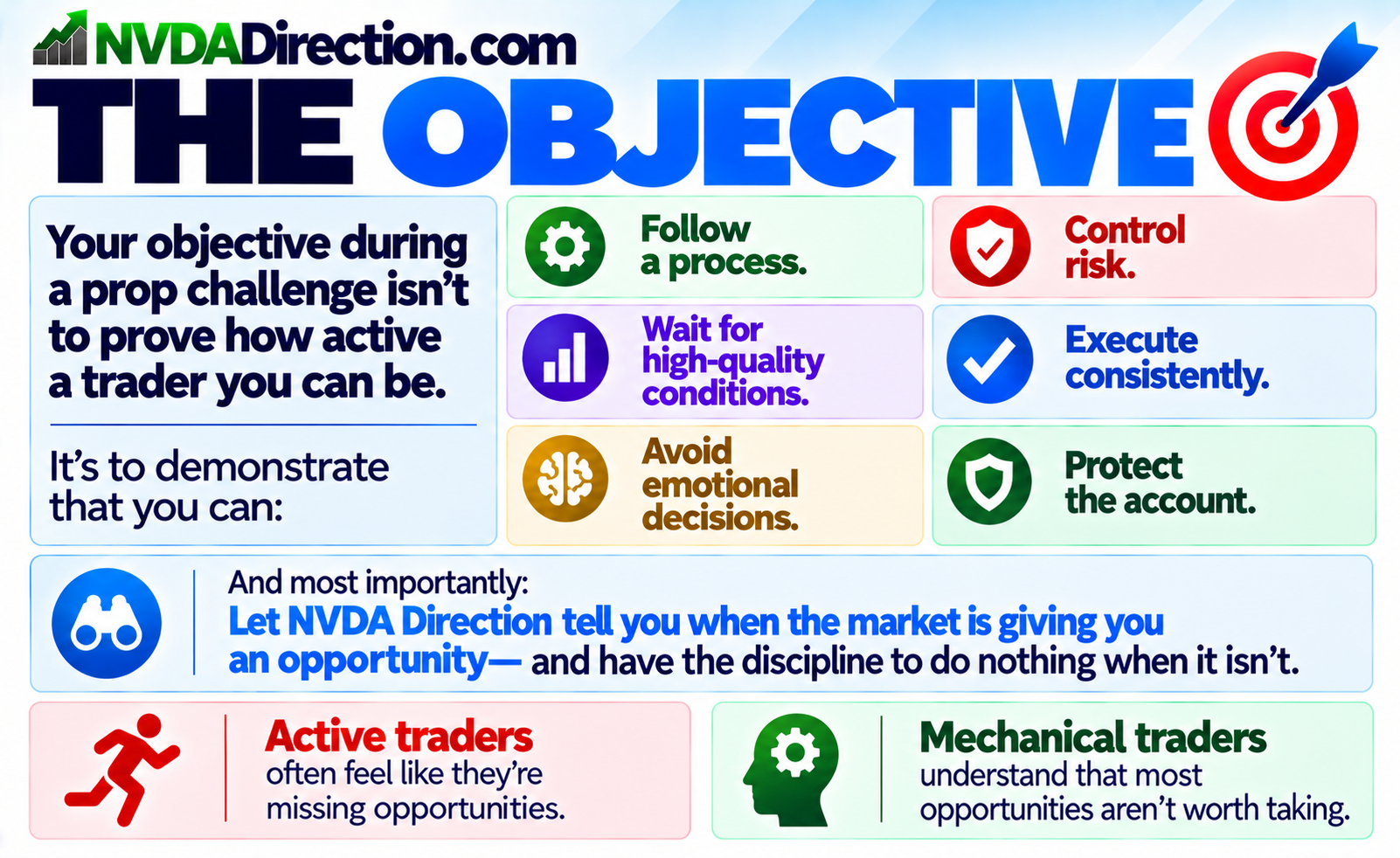
🎯 THE OBJECTIVE
Your objective during a prop challenge isn't to prove how active a trader you can be.
It's to demonstrate that you can:
Follow a process.
Control risk.
Wait for high-quality conditions.
Execute consistently.
Avoid emotional decisions.
Protect the account.
And most importantly:
Let NVDA Direction tell you when the market is giving you an opportunity—and have the discipline to do nothing when it isn't.
Active traders often feel like they're missing opportunities.
Mechanical traders understand that most opportunities aren't worth taking.