Combining RVF, VDI, MA, ORES into a single Trade Probability Score (TPS)
Contact customer support at support@nvdadirection.com to get access to this add-on for Bookmap.
🧠 COMBINING ALL PARAMETERS INTO A CONSOLIDATED SCORE (TPS)
-
ORES provides opening context, but its predictive importance decreases as the NVDA trading window progresses
-
RVF = helps determine if moves sustain
-
NVDA trends = VDI + RVF + MA persistence, not just opening expansion
The following weighting provides a consolidated framework for evaluating NVDA conditions.
🔧 WEIGHTAGE FOR EACH PROBABILITY PARAMETER
VDI = 30%
RVF = 20%
MA = 20%
ORES = 30%
Never Miss a TPS Signal
NVDA Direction can automatically send a text message whenever your selected TPS thresholds are reached.
Learn how to enable SMS Alerts
🎯 THE COMBINED ‘TRADE PROBABILITY SCORE’ FOR NVDA
NVDA Direction displays a normalized score (0 → 1) called the “Trade Probability Score” using input from all 4 probability parameters in real time.
🧠 FORMULA
Trade Score = (0.30 × VDI_score) + (0.20 × RVF_score) + (0.20 × MA_score) + (0.30 × ORES_score)
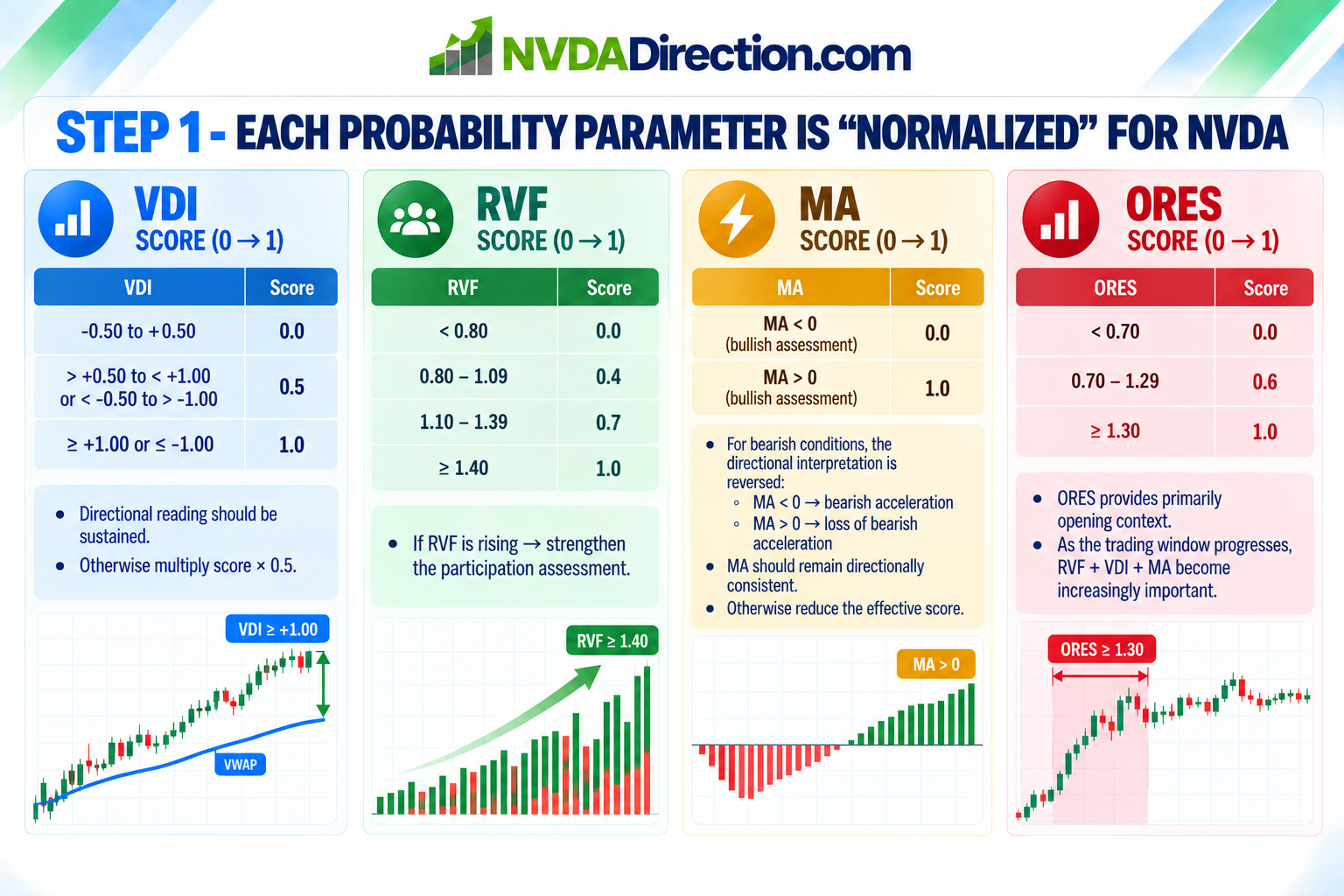
📊 STEP 1 - EACH PROBABILITY PARAMETER IS “NORMALIZED” FOR NVDA
🔵 VDI Score (0 → 1)
VDI between -0.50 and +0.50 → 0.0
Mild directional displacement (> +0.50 to < +1.00, or < -0.50 to > -1.00) → 0.5
VDI ≥ +1.00 or ≤ -1.00 → 1.0
AND:
-
Directional reading should be sustained
-
Otherwise multiply score × 0.5
🟢 RVF Score (0 → 1)
< 0.80 → 0.0
0.80 – 1.09 → 0.4
1.10 – 1.39 → 0.7
≥ 1.40 → 1.0
Bonus:
-
If RVF is rising → strengthen the participation assessment
🟡 MA Score (0 → 1)
MA < 0 → 0.0 for bullish acceleration assessment
MA > 0 → 1.0 for bullish acceleration assessment
For bearish conditions, the directional interpretation is reversed:
MA < 0 → bearish acceleration
MA > 0 → loss of bearish acceleration
AND:
-
MA should remain directionally consistent
-
Otherwise reduce the effective score
🔴 ORES Score (0 → 1)
< 0.70 → 0.0
0.70 – 1.29 → 0.6
≥ 1.30 → 1.0
Adjustment:
-
ORES provides primarily opening context
-
As the trading window progresses, RVF + VDI + MA become increasingly important
🧠 STEP 2 - CALCULATION OF TRADE PROBABILITY SCORE
Score = weighted sum (0 → 1)
The resulting TPS is then interpreted using the current NVDA Direction probability thresholds.
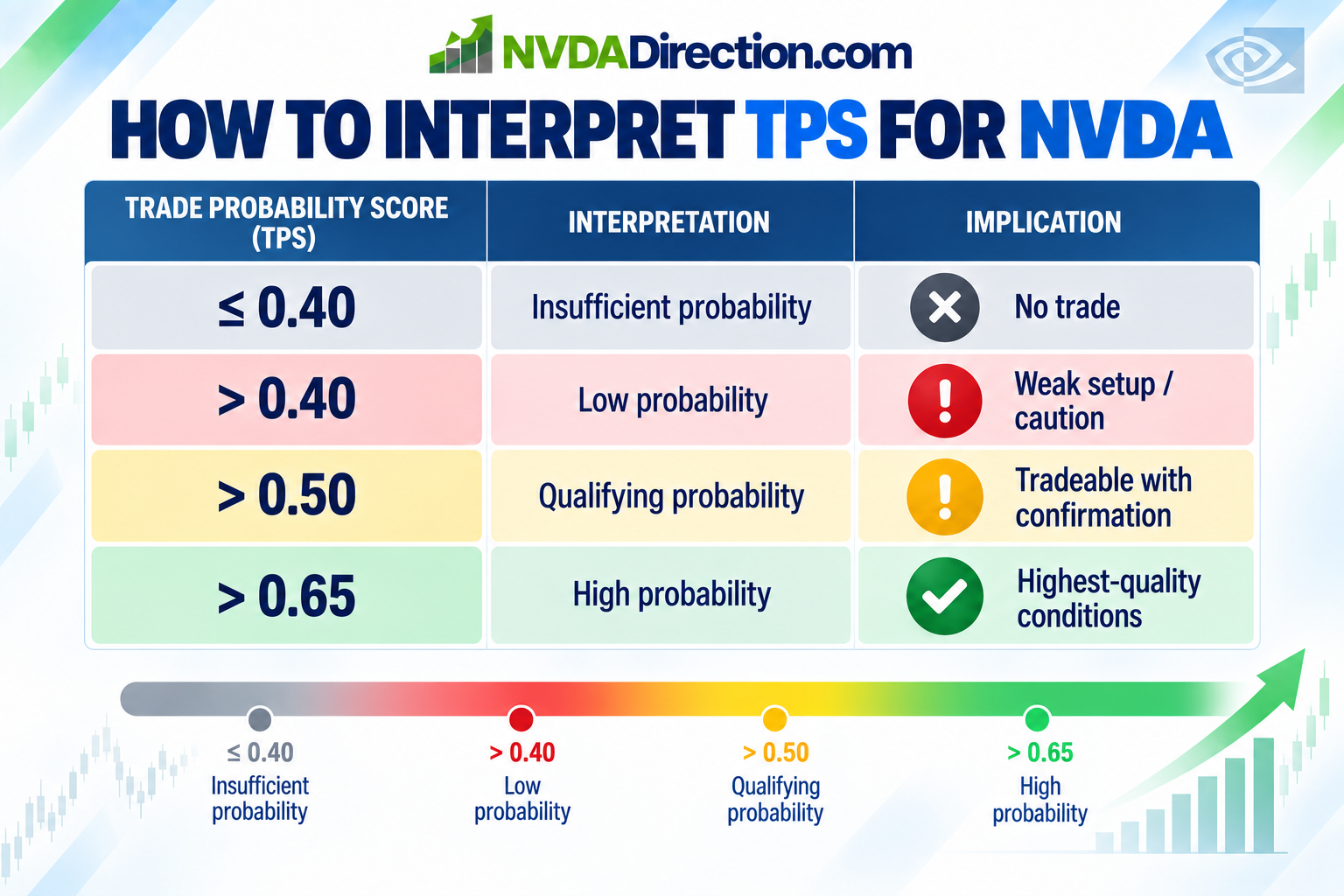
📊 STEP 3 - HOW TO INTERPRET TPS FOR NVDA
| TRADE PROBABILITY SCORE | Interpretation | Implication |
|---|---|---|
| ≤ 0.40 | Insufficient probability | ❌ No trade |
| > 0.40 | Low probability | 🔴 Weak setup / caution |
| > 0.50 | Qualifying probability | 🟡 Tradeable with confirmation |
| > 0.65 | High probability | 🟢 Highest-quality conditions |
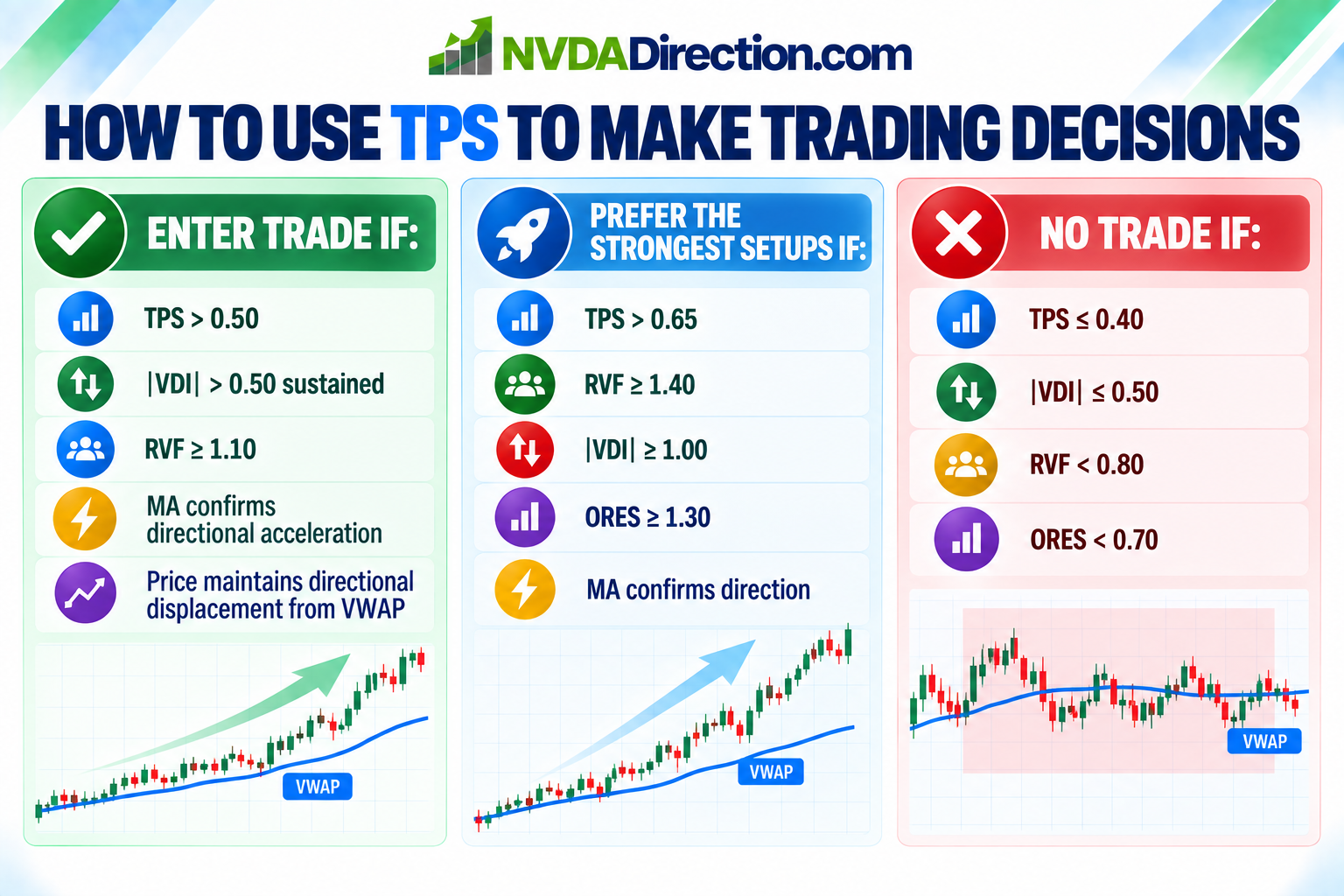
🔥 HOW TO USE TPS TO MAKE TRADING DECISIONS
✅ ENTER TRADE IF:
TPS > 0.50
AND
|VDI| > 0.50 sustained
AND
RVF ≥ 1.10
AND
MA confirms directional acceleration
AND
Price maintains directional displacement from VWAP
🚀 PREFER THE STRONGEST SETUPS IF:
TPS > 0.65
AND
RVF ≥ 1.40
AND
|VDI| ≥ 1.00
AND
ORES ≥ 1.30
AND
MA confirms direction
❌ NO TRADE IF:
TPS ≤ 0.40
OR
|VDI| ≤ 0.50
OR
RVF < 0.80
OR
ORES < 0.70
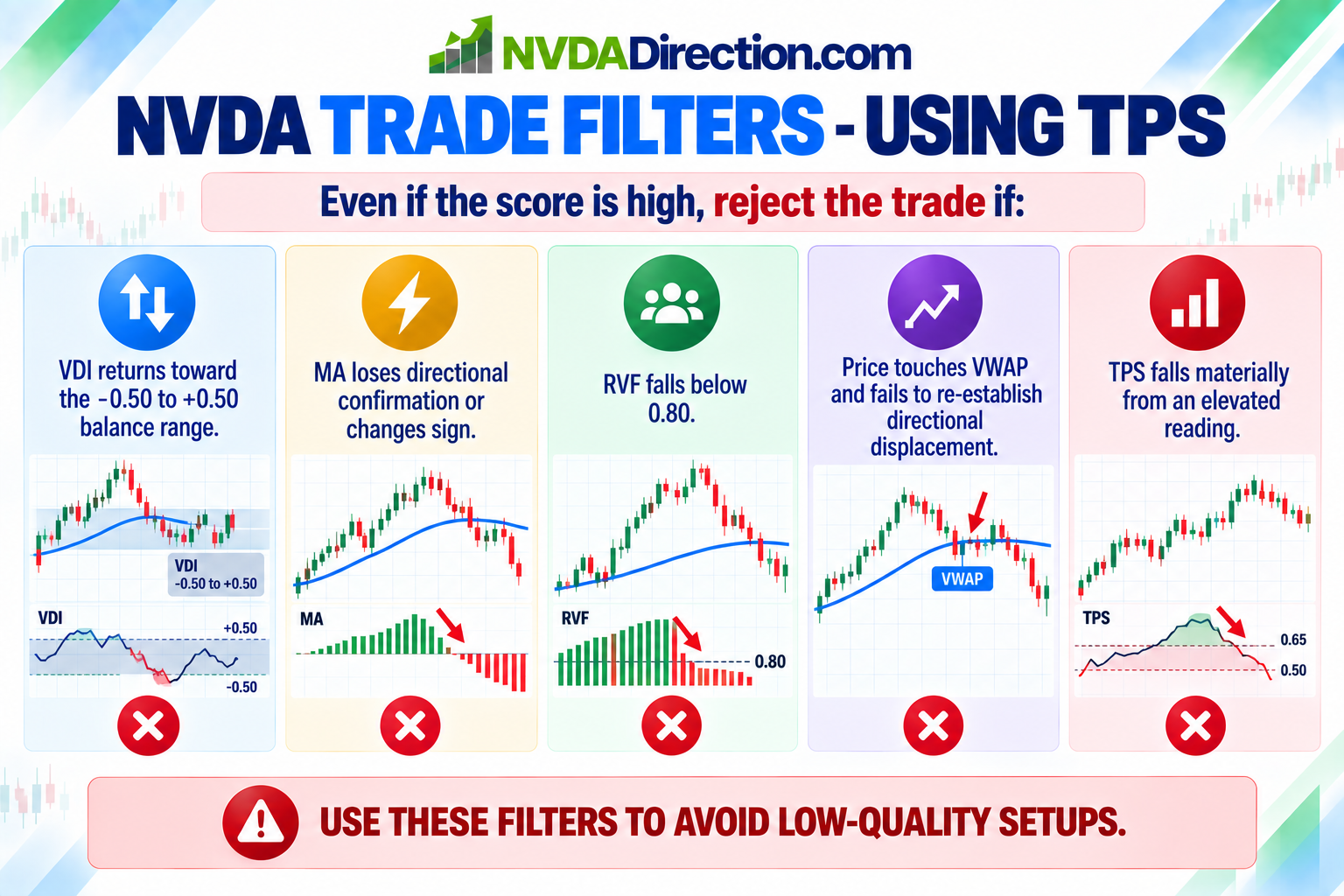
🛡️ NVDA TRADE FILTERS - USING TPS
Even if the score is high, reject the trade if:
VDI returns toward the -0.50 to +0.50 balance range
OR
MA loses directional confirmation or changes sign
OR
RVF falls below 0.80
OR
Price touches VWAP and fails to re-establish directional displacement
OR
TPS falls materially from an elevated reading
⏱️ PARAMETER DOMINANCE ACROSS TIME
10:00–10:30 AM EST → ORES provides important opening context
10:30–11:30 AM EST → RVF + VDI + MA become increasingly important
Trading window ends at 11:30 AM EST.
The TPS should therefore be interpreted alongside the evolving market environment rather than relying on ORES alone.
📊 RESULTS FROM BACKTESTING
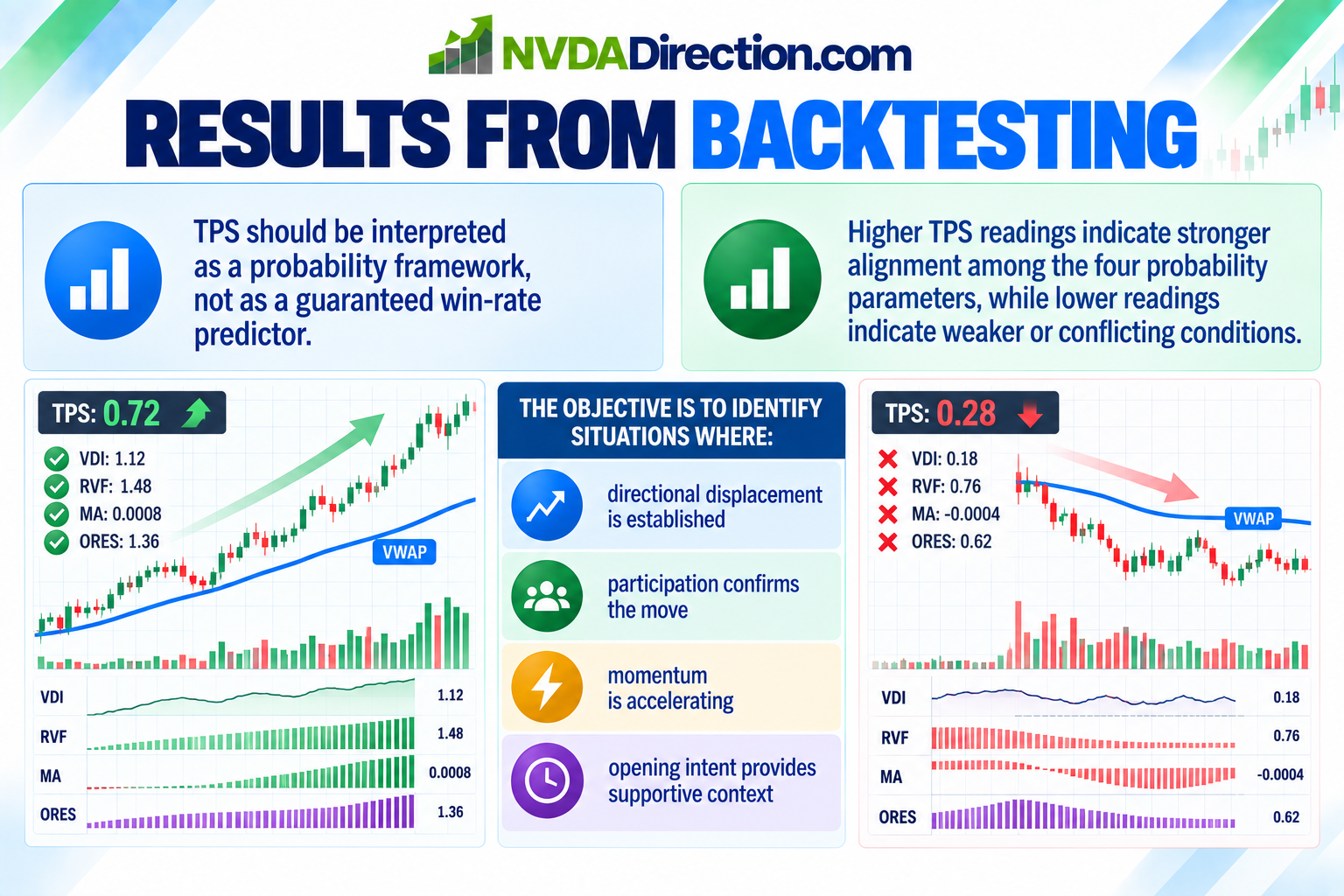
TPS should be interpreted as a probability framework, not as a guaranteed win-rate predictor.
Higher TPS readings indicate stronger alignment among the four probability parameters, while lower readings indicate weaker or conflicting conditions.
The objective is to identify situations where:
-
directional displacement is established
-
participation confirms the move
-
momentum is accelerating
-
opening intent provides supportive context
IMPORTANT CONSIDERATION:
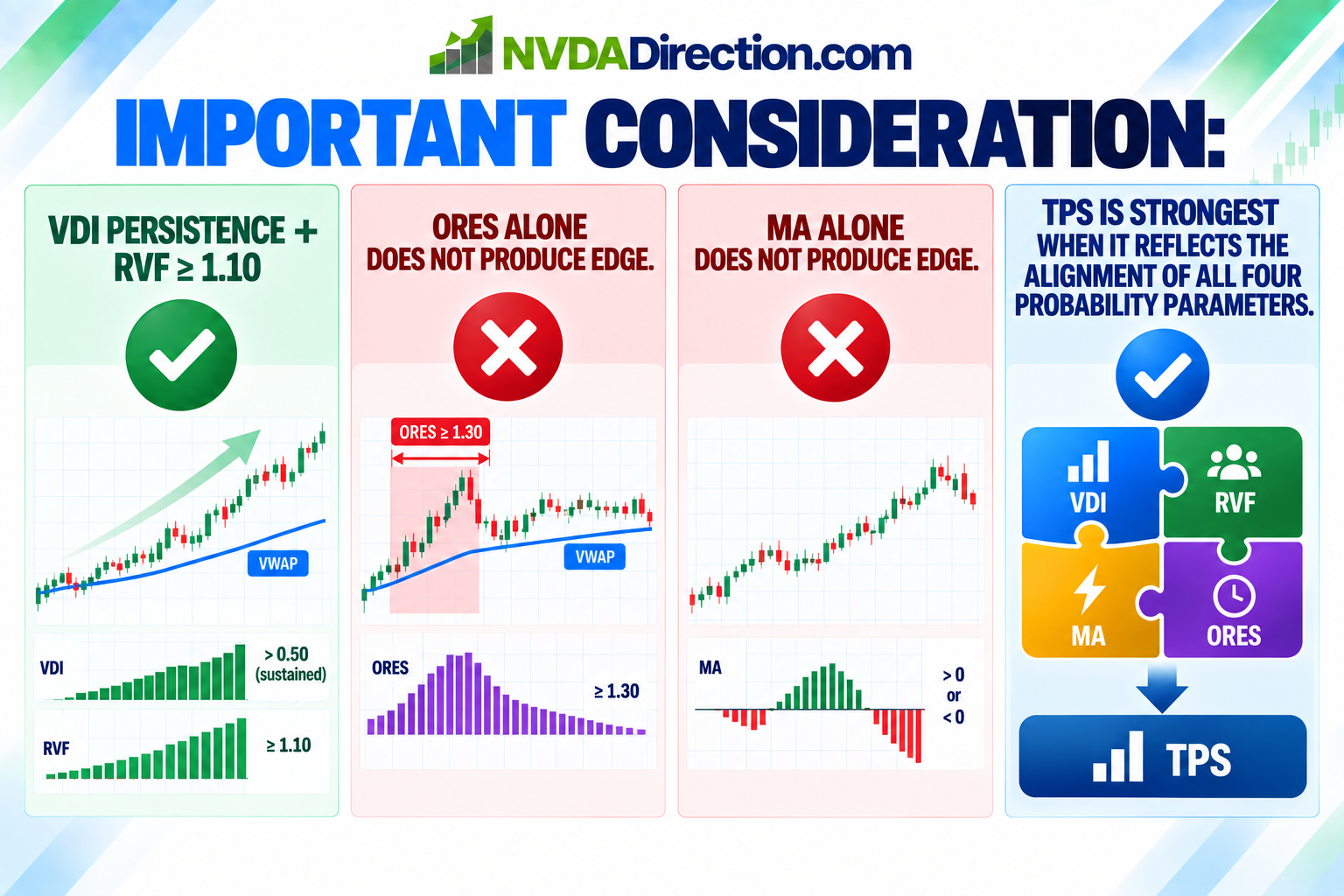
VDI persistence + RVF ≥ 1.10
ORES alone does NOT produce edge.
MA alone does NOT produce edge.
TPS is strongest when it reflects the alignment of all four probability parameters.
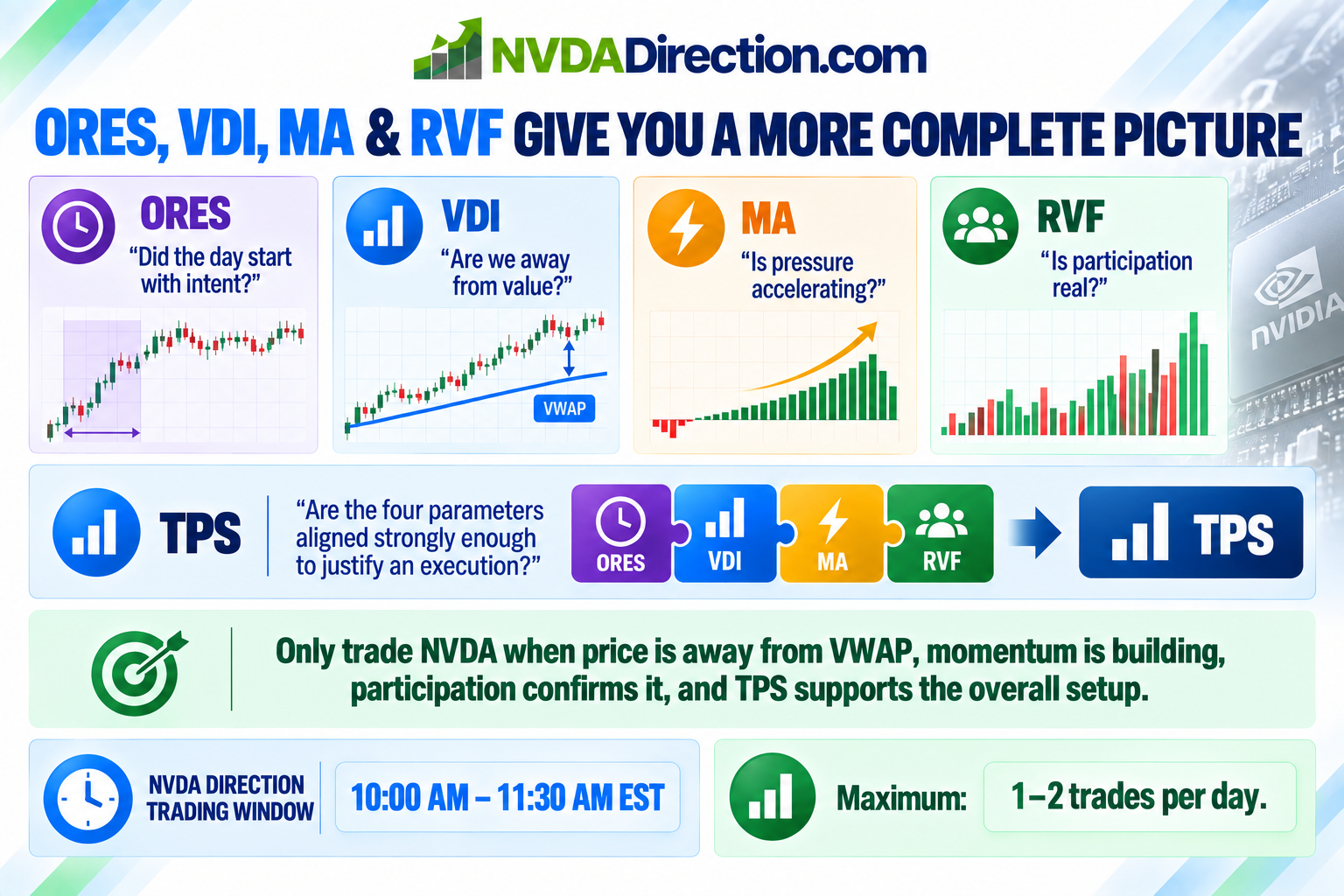
🧠 ORES, VDI, MA & RVF GIVE YOU A MORE COMPLETE PICTURE
-
ORES → “Did the day start with intent?”
-
VDI → “Are we away from value?”
-
MA → “Is pressure accelerating?”
-
RVF → “Is participation real?”
TPS → “Are the four parameters aligned strongly enough to justify an execution?”
Only trade NVDA when price is away from VWAP, momentum is building, participation confirms it, and TPS supports the overall setup.
⏱️ NVDA DIRECTION TRADING WINDOW
10:00 AM – 11:30 AM EST
Maximum: 1–2 trades per day.